Episode Transcript
[00:00:00] Speaker A: I'm Prerak
Welcome to Red, White and Brown, the podcast that discusses the interesting upbringing of Desi Americans and what happens when the eastern culture meets the western world. I'm Pre Rock.
[00:00:14] Speaker B: And I'm Sophia. And today we have an interesting topic all about side hustles. But before we dive into that, we do have three quick South Asian American relevant stories to share with you guys.
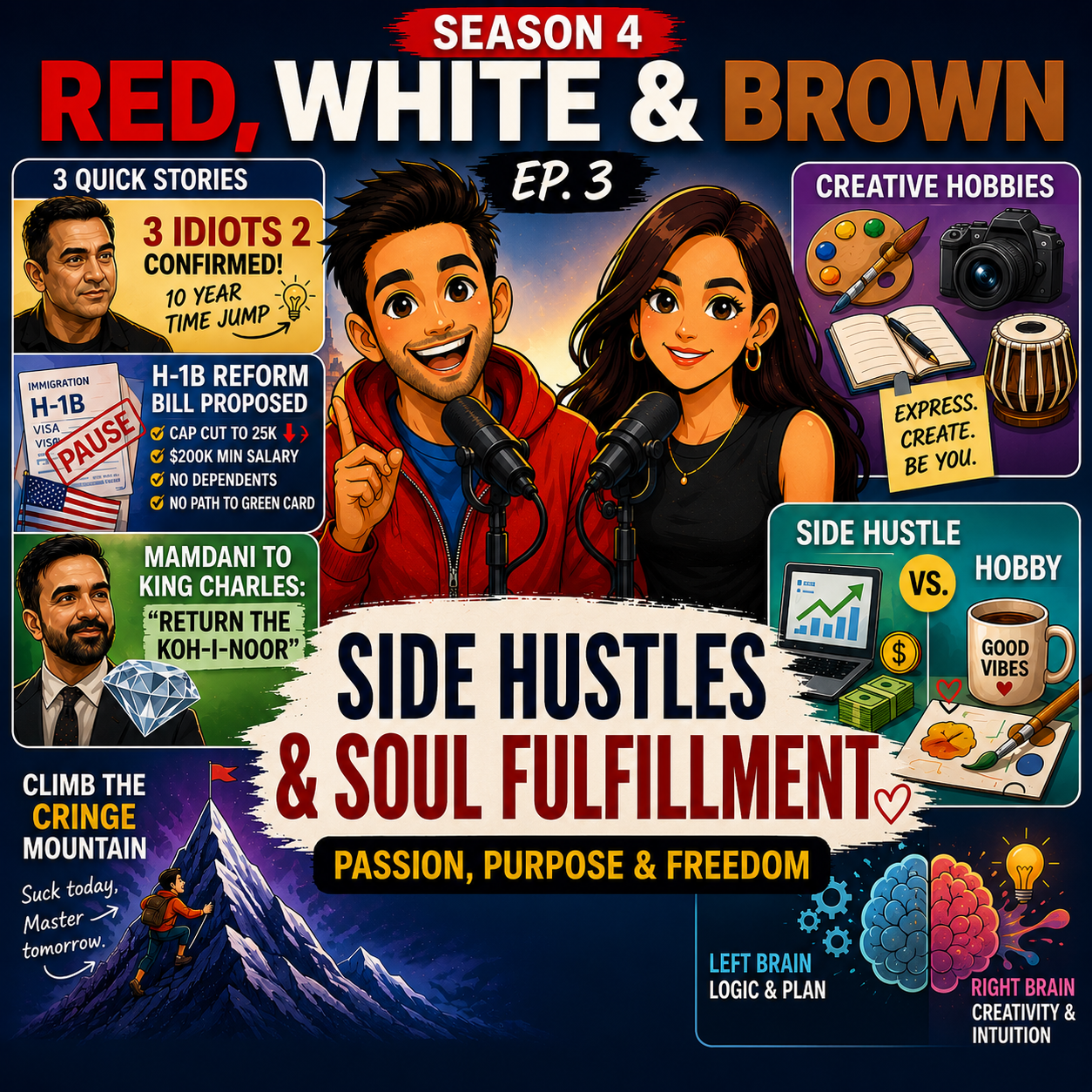
[00:00:26] Speaker A: And I'll keep this short and sweet, but there are two very big stories that actually I was very surprised to see. The first one is the fact that Aamir Khan has confirmed that 3 Idiots 2 is actually going to start premiering. So they're filming this now, which is wild because 3 idiots was such a big part of my childhood. And I'm sure it was for you too, Sophia. And I actually remember you may not know this, Sophia, but when we started med school together, I actually had a screening of 3 Idiots for all of our classmates to watch because I was just like wanted everyone to get a glimpse of how amazing of a movie it was. So we had everyone watch it. So seeing this come out is going to be crazy. And Aamir Khan has confirmed that the timeline is that there's going to be a 10 year time jump and a new story twist with the same director. So I think that'll be amazing. And then the other story. Yeah, it's going to be fun. I don't. Did you watch 3 Idiots?
[00:01:18] Speaker B: I had no idea that you organized a screening. Of course I watched 3 Idiots. That's like a classic.
Wait, really quick. Did the Non Desi people like it? Do you remember?
[00:01:29] Speaker A: They liked it, but it was really long. In retrospect, that was like one of the things I didn't realize. Holy, this is really long. They weren't used to the songs, but it was almost like a three and a half hour movie. So it definitely stretched pretty thin. But people made it to at least two and a half hours, so I was impressed by that.
[00:01:44] Speaker B: Oh my gosh. Yeah, I feel if you're not used to the Bollywood format, that could feel like a little much.
[00:01:49] Speaker A: Exactly, exactly. But I'm excited because that was definitely a fascinating movie and the themes of that movie are probably even more true today in terms of the stressors of getting into school and all of those things.
[00:02:00] Speaker B: Yeah, absolutely. What's the next story?
[00:02:03] Speaker A: So the second story, this one's more relevant for everyone listening who is actually an active immigrant. And what I mean by that is you're on a visa, maybe you're not a citizen yet. And the reason why this is important is because Something in Congress has occurred where one of the Republican House of Representative Representatives has stated that they actually want to limit H1BS. So what they say is that they're actually trying to create a three year pause. They're also trying to limit the number of H1Bs that are issued from about 65,000 to 25,000. They're implementing a $200,000 minimum salary with no dependence, no path to green card and no third party staffing.
And this is important because even though it's not law, the fact that it's even being proposed has massive implications.
Now, people who are on H1BS or thinking of getting them wouldn't be able to get them, especially not for their family. And even if they did get them, there's no definitive path to a green card. I want to emphasize that this is not a law, but it is something that's being brought up and it just tells you about the politics of the United States right now. And specifically it's about the fact that a lot of American representatives feel like immigrants are taking away jobs from Americans. And so they're trying to create this as a way to say, hey, we should be hiring Americans first instead of immigrants, which I have a lot of thoughts about. But I just wanted to throw this out there because it impacts a lot of people and we all know at least one person on H1B. So if you happen to know someone, just bring this up and just know that it's occurring. And at the very least, hopefully it allows you to stay informed. Any stories from your end, Sophia?
[00:03:38] Speaker B: I do have one story, but this story that you just shared I think definitely does indicate the surge in anti Indian and really just anti South Asian immigrant sentiment. And I feel like the Republican Party, I would say with maybe the Donald Trump's first election wasn't so outright with the sort of anti Semitic South Asian rhetoric. You know, I feel like things have slowly progressed right. Over the last 12 years or so. And it kind of just reminds me of this quote that's like first they came for these people and I didn't speak out against them. And then they came for these next people and I didn't speak out. And then when they came for me, there was no one left to speak out. It just feels like it's unfolding in front of our eyes in a way.
[00:04:26] Speaker A: Yeah. And it's all part of this America first agenda, which again, we don't try to get too political about this, but when it impacts everyone and the way we see ourselves in the broader context of The American, Canadian, whichever state you're from, population immigration has a very key role in making all of these countries what it is today. And so when these tides shift, it is important to acknowledge it and at least speak out against it. So I, for one, don't particularly support this. Again, it is created by a Republican representative. It probably won't actually pass, but it just goes to show you some of the sentiments that exist.
[00:05:00] Speaker B: Yeah, I agree. And obviously we don't want to get too political, but I do think when South Asians are kind of spoken out against, I think it's fair for us to comment on it, since we are the ones kind of impacted by that.
[00:05:13] Speaker A: Yeah. When it does impact our community, I think we have to be more vocal about it because this is how it starts. And before you know it, it's like the lobster that's in the boiling pan. Right. You're already being boiled and you want to speak out before it gets to be too late.
[00:05:25] Speaker B: Exactly. And I will quote a couple of things that President Trump said, said earlier this week, one of which being he was talking about birthright citizenship and talking about how people from India and China. He is saying, quote, unquote, abuse the privilege. So he said, quote, a baby here becomes an instant citizen, and then they bring the entire family in from China or India or some other hellhole on the planet, end quote. Which, obviously, that's a very offensive thing to say.
[00:05:53] Speaker A: Yep. And he's done this before. I mean, this is not his first time. Right. He's literally said, like, why can't we have immigrants from Norway or Switzerland where he just wants immigrants that look white, essentially. Right. And as opposed to immigrants from other countries that don't necessarily look like the typical demographic. So this is not the first time he's been xenophobic. Certainly not going to be the last time. But it is something that we know is the undertone of this administration and it plays a big role in it for all of us. And as I said, I used to never follow politics because I was not a citizen, but I realize how important it is to follow because these news like the H1BS have direct impacts on us. This would have impacted my dad back in the day, sure as hell would have impacted most of my friends, parents, and actually probably impact a lot of my potentially people who are like me, working at Google, Amazon and all these places right now.
[00:06:40] Speaker B: Absolutely. And now that you mentioned Google and Amazon, I'll quote one other thing that Trump said earlier this week talking about jobs in tech. He said, quote, I used to be a great supporter of Indians in India until I opened Indians in India. What the hell? The way this man talks.
I can't even get through this without laughing. Okay, I used to be a great supporter of Indians in India until I opened my eyes up to what's going on here. White men need not apply to jobs in the state of California, never mind in high tech. I don't care what your qualifications are, you're not getting a job in high tech in California. So he's basically saying the Indians are taking all the good tech jobs, which, look, if they're qualified and they're engineers, like, how is that their fault? Like, it's just so ironic and crazy. And maybe our country needs to invest more in education so we can produce people who are engineers as well, but that's.
[00:07:32] Speaker A: This is not conducive at all. What it's. What it just creates is a lot of infighting within the same country, right? A lot of Indians have consistently. Pakistanis, anyone has consistently said that once you become a citizen, you feel American. And it's rhetoric like this that still leads us to say, hey, are we really American? And actually is one of the reasons we made this podcast, right? Like, we say that we're American, it feels like we're American. We're supposedly American, and yet our experience is so drastically different. And it's part of all of these sorts of sentiments that will probably never end, but probably have a big defining role in the way we perceive the world. So, yeah, it is what it is. It's actually a really good way to start the show because it is a great way to speak about something and still use our very small platform to bring awareness to this issue. And we'll continue to do that.
[00:08:21] Speaker B: And then I have one other story, a lighter story after this H1B headline. So this came out yesterday as the day we're recording, which is that. So King Charles was visiting the US and Zoran Mamdani, the mayor of New York, in case those you don't know him, was at an unrelated news conference. And he was asked what he would talk to King Charles about if he were to meet him. And first he gave a diplomatic answer, but then he said, and I'm going to quote, if I was to speak to King Charles separately from that, I would probably encourage him to return the court Kohinoor diamond. And I thought that was something a lot of South Asian Americans could probably appreciate, just since the diamond was mined in modern day South India and it's now in some museum in the uk. I don't even know which museum, but I feel like a lot of us who ethnically come from countries that were colonized do have a soft spot for the riches of those colonized countries being taken away from the lands that they originated from and being used to enrich the colonizer countries. Right. So it's always nice to hear someone speak truth to power.
[00:09:22] Speaker A: Zoron, man, this guy just somehow knows so much.
I don't. First of all, I don't know what this diamond is, but his ability to relate issues across different countries while also balancing the hat he wears as New York City mayor, but also who he is as an individual, which is a South Asian, is actually incredible. And that's why I think he relates to so many people. Americans see him as the mayor of New York City, but you and I see him as one of us. Right? Like a first gen immigrant. And so he has this ability to wear multiple hats, and it's almost as if he can switch between things, which I think is actually a pretty good segue into our bigger topic of today.
[00:09:57] Speaker B: Wait, hold on, wait. Before we just move away from that, did you say you don't know what the Kohi Noor diamond is?
[00:10:04] Speaker A: Yeah, I don't. Is that bad?
[00:10:06] Speaker B: Oh, my God. Wait, yes, you must. Okay. It's a really big diamond. I think it's the biggest diamond in the world. It's 105 carats. I just had to Google this. 105 carats.
Okay, this diamond. Let me give you another reference point. I'm pretty sure it was.
[00:10:20] Speaker A: Wait, let me. Let me guess. The price of the diamond. You said how many carrots?
[00:10:25] Speaker B: 105.
[00:10:26] Speaker A: Okay, you look up the price, but I'm assuming it's got to be maybe a billion or a couple hundred.
[00:10:31] Speaker B: I don't think it's up for sale.
[00:10:33] Speaker A: I know it's not up for sale, but it's gotta be. Okay, the fact that I didn't know about it is good because now you explained it to everyone, so they also will know, assuming they're not as stupid as I am. But thank you for educating me. But yeah, I definitely did not know this existed.
[00:10:47] Speaker B: I'm joking. Okay. The price, you said over a billion. Is that what you said? It is.
[00:10:51] Speaker A: Yeah.
[00:10:52] Speaker B: I see. From.
So the estimate ranges from 200 million to over a billion.
So wide range, because it's not. It's obviously not, like, up for sale. So this diamond, I'm pretty sure it was in one of the doom movies, that they're trying to steal it or something.
[00:11:07] Speaker A: I probably just didn't acknowledge it. I just assumed they're trying to steal the diamond.
[00:11:11] Speaker B: It's like some big diamond. Yeah.
[00:11:13] Speaker A: I didn't know Doom was based on real events because they do a lot of stuff there that definitely is not realistic. Like Rik Roshan dressing up as a drag queen, essentially, and not getting recognized at all.
[00:11:24] Speaker B: It's just so funny.
Yeah, fine.
[00:11:27] Speaker A: Fair, I guess. Now that we have acknowledged that I know a lot about random politics but don't know enough about basic general knowledge, I think we can pivot to the actual bigger topic of our episode, which is about side hustles, creative hobbies, different things, things you want to do with your time that may not necessarily be condoned by they see American parents or even more broadly society.
So I obviously have a side hustle. My side hustle, which I actually like to call a Hobby, is my YouTube channel. And of course, this podcast, which is something that Sophia and I actually make time out of our week to do all the time, even though it's not necessarily something that brings money or even any other real monetary value. We just like doing this. Sophia, what are your thoughts on creative hobbies and side hustles?
[00:12:11] Speaker B: Obviously, I have a couple creative hobbies and side hustles, this podcast being one of them. And I wanted to open up this discussion with you bringing up a point that I heard on TikTok, which is unfortunately where I get some of my news and pop culture awareness. But I wanted to bring up this point I heard, which basically comments on what happens when our community, like the South Asian American community, does not value the arts.
Which I think, as you said, like, a lot of times, our community doesn't super encourage us to pursue the arts and these creative hobbies. And so instead of explaining what she's saying in the video, I think I'm just gonna play the clip and maybe we can hear what you think.
[00:12:53] Speaker C: I saw a creator on here saying that the Dice Diaspora Daisy Diaspora community has gone too far by, like, yes, like, kids don't actually have to be doctors, lawyers, dentists, or engineers, but now they've gone so far as to just slap a bunch of, like, mangoes on a T shirt and put an ordeal phrase and then sell it for, like, $50. And I think that's true. And I think this is what happens when a community doesn't value art. Because, yes, like, kids should, like, don't have to be the dentist, lawyers, whatever, but then send those kids to art school, like, pay for their art classes, send them to a drawing class, send them to fashion school, whatever they really want. Because now the kids who want to be creative, they don't have the skill set to, like, be good artists, because art, real good art, takes years of training and skill. And a lot of these kids just want to skip to the whole selling the merch part. And they don't realize that it takes a lot of learning and mistakes and whatever. And this is, again, what happens when a community doesn't value quality craftsmanship and artisans.
[00:13:55] Speaker A: I want to play devil's advocate to this, but it's hard because she has a pretty solid premise. I think, yes, in this generation there's definitely more slop, especially with the amount of AI There is. But I do agree that this is primarily a result of the lack of focus on the right brain aspect of creativity. Right. We have a right brain and a left brain. Right brain does have these creative aspects that I historically think we do not focus on nearly as much. However, this aspect of saying that we have not focused on the arts may be true now. But I will say us as a subcontinent, like when whenever we go to India, we get some of the most antique foundational jewelry, arts, creative stuff that I've ever seen. And while maybe currently there's a lot of slop, Maybe it's particularly D.C. american problem in America, because I definitely do think in the subcontinent, there's been, like, pretty impressive generation of creativity in a lot of unique ways. If we are truly just putting mangoes on T shirts, I do think that's a problem. And I think that' definitely a low point. And we should probably be thinking about how we want to amplify messages that are deeper than that. But I will say in the subcontinent, we definitely have done something right, because the level of arts there is truly next to none. And you find it in some of the most nuanced nooks and crannies of any town.
[00:15:09] Speaker B: I fully agree. I don't think she's talking about the subcontinent. I think she's only talking about South Asian American culture. Because I, of course, like the subcontinent. There's art at every corner, whether it's the clothes, the jewelry, the music, the food. It's all. There is so much art that is undeniable. But I think she is bringing up this point of South Asian Americans not necessarily pursuing artistic hobbies and crafts very rigorously. Yeah, sometimes people have hobbies, but it is pretty rare to see someone, for example, who's into playing the tabla or the sitar and really taking a lot of lessons and practicing and Intensely pursuing that art to become the best tabla player that they possibly could and doing it as a career. I gave an example of South Asian instruments, but even guitar or whatever, right? Like, how often do we see a South Asian American trying to become a professional musician? It's rare, right. Among our South Asian American peers, I don't think we see that too much. And that goes for all the art forms, right? Visual arts, filmmaking, singing, Even with dance. And I will say, I don't know if you know this, but there is a culture of competitive South Asian dance teams in the U.S. i don't know if Berkeley had that. Princeton didn't really, but I know it is common at a lot of schools. And so dance, I would say, is the one form that I think people pursue competitively, but not necessarily to the point of it becoming their career. Like all these South Asian Americans on these dance teams are not trying to become professional dancers. They're like going into finance and medicine and law and stuff. I don't know.
[00:16:52] Speaker A: I. I see where Berkeley did have that. They had, they had multiple dance teams. They had Azad, which is the boy girl dance teams. They have a all boys dance team. They also have an acabella group. So there's definitely. That's the beauty of college. I think it shows you that you can take this and actually create it. The one part that I think I have to either disagree or at least we have to figure out a way to nuance is that we're not. There's certain parts that were discouraged. But I also think there's one part where you don't even know that you can turn these things that are deemed your hobbies into careers, right? So, for example, we all know that we could become professional basketball players because you see the NBA every day or you see the NFL you grew up watching and you're like, oh, if I became a great basketball player, I could go to the pro. And believe it or not, we can even use that as an argument. Sophia, because I think that substantiates our argument here, right? Like how many Indian or they see Americans are there in the NBA?
[00:17:45] Speaker B: Zero.
[00:17:45] Speaker A: But it is changing. It is changing. So we have a few, but that's one thing. But then there's this whole other batch of hobbies that I don't even think we realize can be careers because we've never seen it, right? You grow up. And how many times when you went to a family function did you meet a professional dancer as one of your family friends? And it's not going to Happen. But how many times did you meet an engineer, doctor, lawyer, someone in business? Probably almost every time. So what you grew up with and what I grew up with was realizing, hey, I could like dance, but how would I ever pursue it? No one's showed me how to do that. If anything, my, my auntie did a lot of dance and now she's a businesswoman. So I guess everyone becomes a businesswoman, right? That's how we grew up thinking this is not really a career. And let's say you did have the balls to say, I do want to do this for the rest of my life. That's when I think some of that discouragement does come in where you might actually feel those external forces saying you're not going to do it. But at least growing up, I personally never even realized I could be a professional dancer. And that might be changing in this generation because people have TikTok, they have YouTube, they're seeing people do these things and having a living out of it. But at least when I was growing up, I was like, you're either going to go study school and then become a business person, or you're going to be a doctor or a lawyer or an engineer and work at a company. I didn't know you could make money doing anything else.
[00:19:01] Speaker B: Pre Rock. I am here to tell you, if you want to become a dancer, I give you permission to do that. I don't know if they would.
Would be on board of you. You finally finished residency and have a job. But, you know, if you want to pursue dance, you don't. Don't rule it out.
[00:19:21] Speaker A: I don't think anyone wants to see that. But I will say I was on my high school dance team and ever since then, it's been downhill. But that's what I'm saying, right? I did all of these things and actually when I made this episode, I didn't even realize I did that because I just. It went over my head. It was just something I was doing for college because there's just some extracurricular. But in retrospect, I did like it. It made me happy. I got to meet a lot of cool friends through it, and yet I didn't even realize that it was something I did that was this. Right. Brain activity.
[00:19:48] Speaker B: Yeah. We saw some dances at your wedding, right? From the dance team. So yeah, that's awesome. But I will, I will say I wonder if it is different in the subcontinent. I think it is. And I think it is more common and accepted in the subcontinent to pursue art rigorously and Professionally, I personally know multiple people who are fashion designers in South Asia. And that's just one data point. But if I am one person and I know a couple people who are fashion designers, that just tells you I think it is a little bit more common and maybe the barrier to entry is a little lower in the subcontinent and it feels more accessible. Maybe somehow and non South Asian Americans, ethnically white or black Americans might say that they think it is common to see people pursuing the arts, but maybe our community, South Asian Americans, just hasn't quite gotten there yet. And so that's why we feel like we don't ever really see that. I think there's this sense that a lot of us feel like we have to earn quote, unquote, creativity after achieving stability or something practical. Would you agree with that?
[00:20:57] Speaker A: Yeah, I think creativity, at least in my mind, was always a privilege. You can go color after you finish your math problems, or you can go, I don't know, play video games. People shit on video games, but I do think video games are a form of creativity. Right? You're engaging with an open ended problem, but you can go play video games after you finish your math problems, or you can go to dance practice, but you can only go if you finish math problems. Right. The way we're brought up is almost like all of these things that are hobbies are second to the basics, which is actually all the right brain stuff that we were talking about. I've seen people who've had these hobbies and then guess what? By the time they're 20 and 30, life comes at them. They're going college, they go into medical school, they're doing residency. All those hobbies that brought them so much joy, they slowly dwindle away because they were brought up with this. Hey, you can only do this hobby after you get everything done on your checklist. And guess what? In residency, that's never going to happen. If you really wanted to finish everything on your checklist, there's no way your hobbies will ever get done. So you have to make a conscious effort, like we did to try to create the bring the podcast back, otherwise it's going to go away.
And so having those hobbies has at least to me, always been like a privilege. But I think this is where the value of this episode comes in. Is that correct? Is that right? Is that something that we need to change? I don't know. What do you think? Tell me about your journey with creativity.
[00:22:18] Speaker B: I love the example of you can color after you finish your math problems. That is so relatable. Oh, my gosh. But in terms of my own journey, I think I was creative in high school, and I think my parents supported it to the extent that it helped me with my college applications. Right? Because they understood that it's not just grades you have to these other extracurriculars, yada yada. But I think even that I had to earn that freedom to do something artistic just by getting good grades, right to the point where they would be like, okay, academically, you've checked that box. Now you have to do this other XYZ thing to get into college. And even in that situation, there was this quote, unquote, practical end to it. Right. It wasn't just pursuing creativity for the sake of creativity.
I really like to sew and design clothes. And that was something that was going on my college application. So there was this practical end to it. And now I would say, I don't think I put that on myself. I think something has shifted with, I guess, with having this career in medicine I've allowed myself to. With this podcast or Instagram or whatever. It's not like I need to make that my career or make that my income source. And so I'm able to pursue these things just for the sake of creativity. And so I think now it's different than when I was younger. Have you experienced that? What do you think?
[00:23:39] Speaker A: Yeah. And I agree. I did. Everything I did in high school was to get into college. There was not a single part of me that was, yes, it made me happy or fun. Like, I did track and field. I liked it. I did the Indian dance team, I liked it. I did volunteering, I liked it. But if you really asked me what was the goal of it, and it was just because people told me I needed to do that to get into college. So because of that, I think, again, it reinforces this hierarchy that we just learned, which is like, hobbies are a privilege, they're cute, but at the same time, you're not going to probably pursue them. However, I do think it's worth pointing out that I think our parents probably had these views they were optimizing, again, for survival because the only world they know is their own. And in their world, I don't know about your parents, but my parents is just, okay, you got to get a stable job. You're not going to get that during dancing, and especially not when I'm on this H1B that Trump's going to take away. And sometimes, right? So, like, they're not. So they're not going to really be okay with that. Right. If I'm going to. If I have this like, non zero threat that I'm going to be kicked out of the country, why would I risk it for a very tough career?
[00:24:42] Speaker B: Of course. And if you or me had to go and build a life in some other country, if we were sent to Norway or something, all of a sudden, I don't think we would be telling our kids, oh, yeah, pursue Indian classical dance. No, it would be like, okay, learn the language. Get a stable job and figure it out.
[00:24:57] Speaker A: Exactly. And. But I guess the question, is this right or wrong? Because I do think, I don't know. Every time we meet for this podcast or every time I make a video, and I don't know if you feel this, but if I make a video for the sake of making it for myself, I feel happier. Like it's this different part of my brain that's activated that I don't think we get anywhere else. And I think there should be some value to, like, finding a way to balance those two things.
[00:25:21] Speaker B: I completely agree. I think this other thing that I would want to bring up, which I don't know if you've seen videos on this debate, but it's a side hustle versus hobby trap. What. What are your thoughts?
[00:25:33] Speaker A: I think I have a lot. But let me clarify, what do you mean by the trap?
[00:25:37] Speaker B: I've seen a lot of people talking about how basically people try to turn their hobbies into a side hustle nowadays and earn money from those hobbies. Whether that's something like making paintings, making jewelry, knitting, whatever. People open a shop on Etsy and try to do this side hustle.
And people then say it takes the joy out of it when you're doing it for money rather than just doing it for the pure creativity of it. And I think people become a little conflicted on should they just pursue something as a hobby or should they really try to get into it and turn it into an income source?
Is it worth it to do that or does it just suck the joy out of it? I think is the question.
[00:26:20] Speaker A: Yes. I have so many thoughts about this because a hobby is something and I define this by what my hobbies are. Right. My hobbies are running, spending time with my dog, hanging out with someone at the park. Like, hobby is something that brings you joy to a certain extent. It challenges you, but it puts you in a flow state. And I think time goes fast when you're doing a hobby. It gives you a chance to, like, just be yourself without being judged or Graded a side hustle. On the other hand, when you try to turn that hobby into a side hustle is when you start running into this very interesting thing that your brain puts on you, which is the dopamine hits. So, for example, now let's say you want to monetize your channel. You were creating videos just for fun. You happen to monetize it, and you saw that one video, got you a ton of views.
Those views, even though you don't know it, are dopamine hits to you. And so you want that dopamine hit again. So instead of now making a video on something you actually want to make a video about, you're now making a video about what you think other people want you to make a video about. It's like this crazy game theory. And now instead of doing stuff that truly makes you happy, you're doing stuff that's going to optimize for views. And exactly what you said, now you're just trying to get this external marker of validation, which is views, as opposed to, like, truly doing what you want to do.
So I don't think a side hustle is. I think a hobby can be a side hustle, but when you side hustle too hard, that side hustle gets rid of your hobby altogether. That's why you see people burning out from content creation. They don't re. They don't really like doing it anymore. They just do it because it pays the bill. And so the more and more you do it, I think the outputs change. And especially if you try to change something into a side hustle, I'd say if you're truly trying to keep your hobby as a side hustle, you can't get too stuck to the metrics, whether that's likes, views, whatever external monetary thing you're getting. If it's truly a side hustle, it should. You should be fine making zero money from it. Right? Because it's a side hustle. You have a day job. If you truly want to use your hobby for that, then maintain the integrity of the hobby. But the more you start saying, my hobby is a side hustle, the more that side hustle part's going to take over. And it's probably not going to be a hobby anymore. You're going to feel like you're doing it just because you're trying to get the most views. And that kind of corrupts everything in my mind.
[00:28:35] Speaker B: Yeah, I see what you're saying. But going to this point that the tick tocker we mentioned earlier hinted at, do you feel like in order to pursue something really to the most excellent degree, you need to make it your career. Do you feel like you have to essentially devote your life to something if there's a craft that you're passionate about? Because that's the other side of the argument that she is making. Right. It's without really pursuing excellence in. In a craft, it's always going to be half baked. She gives this example of these South Asian American diaspora brands that will put Shah Rukh Khan's face on a sweatshirt and sell that as merchandise.
And she's saying that's not real art. True. Like fashion as an art form, pursuing that to the most excellent degree is a lot more than slapping a print on a hoodie. So what do you think?
[00:29:27] Speaker A: I think that's correct. But I think there is value in doing something half baked. And you do this a lot, Right. Guess what we did in medical school, right, Sophia, you do all of these rotations and you use them to decide what you really want to do. In a way, we are doing each rotation half baked because you're not an anesthesiologist when you're doing the rotation, but you're using it to see what you like. And if something truly speaks to you and you say, I love this, I want to really go all out with this. You cannot half bake what you want to do. Eventually when you do residency, you don't get to do residency in all of the rotations. You pick one or two things. You don't get to be a neurosurgeon and a cardiothoracic surgeon. Right. And I think that's the problem that I think sometimes gets conflated. I think you can do things half baked as a way to explore what brings you true joy. And then if you really want to, you realize something brings you really a lot of joy and you want to be the best at that craft. You have to not have any plan B. And this is all. I don't know if you've read Malcolm Gladwell's books. Malcolm Gladwell outliers, right? So he has the 10,000 hour rule where you have to do 10,000 hours of deliberate practice in any complex skill to truly become an expert at it. And I think this is true even for crazy things like YouTubers, right? Like how much time do you think Mr. Beast puts into making a video? Or how much time do you think these tiktokers who have millions and millions of views actually take to make one perfect TikTok? It's actually way more than you would ever Expect. Yeah. So I think you have to be honest with yourself. If you're doing something as a hobby, I think doing it half baked is fine because you're not trying to be the best at it. You're just trying to be in a flow state. You like what you're doing. But if you're truly trying to be a violinist or you're inspired by Yo Yo Ma and you want to be just like him, you're not going to get there by doing it part time after school as a thing that's going to get you into college. You have to go all in and realize, hey, I'm going to take a risk and this is what's going to happen. Analogies for this are endless. Right? The same thing with startups, same thing with companies. Tim Cook does not do anything else except be the CEO of Apple. Right? His side hustle is not, oh, I want to trade stocks. You have to be a full on CEO if you want to do this job and you have to make that trade. It might work, it might not. But I do think there is a value in going all in on one thing.
[00:31:41] Speaker B: Yeah, I think that's so fair. And the other point that you reminded me of as you were speaking just now was this fear of being seen trying that person who wants to become a violinist. I think sometimes people are self conscious about saying that, hey, I really want this, I am taking this risk. And I think that affects adults a lot more than it affects kids actually. Because I think it's harder often for adults to try new things or pursue new hobbies or even go on this whole hobby versus side hustle journey to begin with because they're self conscious about being seen trying in public. And this whole discussion is a moot point if someone is thinking, I really want to do any certain hobby, but I'm just so self conscious about what will people think if they see me doing this. And there's a term or a phrase, it is called climbing cringe mountain. Have you heard of that?
[00:32:33] Speaker A: I've never heard of that.
[00:32:34] Speaker B: I think you'll understand it. But it's basically this metaphor of that uncomfortable, awkward period in the beginning when you're trying something new, like you're trying to learn a new skill and you're putting yourself out there publicly. So think about when you first started making videos before you had 20,000 or 50,000 or however many YouTube subscribers that you have now. Those first few videos, right, where people see you trying this thing, they probably have all this criticism on it saying, oh, prereq thinks he's a YouTuber now. Or Sophia thinks she's an Instagrammer now. Whatever. Right. Like the types of things that people would say, but you have to go through that initial phase in order to get to the other side. Like where you are now, where you have this huge YouTube channel, and now no one would look at you and criticize and say, oh, he thinks He's a YouTuber. You are a YouTuber. You got there. Right. You got through it. But there's no way to make your thousandth video without making those first 20 where people do think you're cringe. So that's what that phrase refers to.
[00:33:34] Speaker A: Yeah. And I think everyone has cringe moments. I think the funny part, the reason why I think you're so smart to. And you're a pediatrician, so I guess it makes sense why you would know this. But kids have such a lower barrier to being cringe because they're still kids. They're undifferentiated in a way that adults are not. So when someone sees me going out to play pickleball, they're like, who the hell is this guy? He's already a doctor. They already have a set Persona. Me, he's the doctor who likes running. Why the hell is he trying to play pickleball? And so we create these niches more and more. But I think as you grow older, if you truly do want to spark something new, we just accept that there will be these moments that are cringe, and you have to put yourself out there. Whether that's in the form of learning a new skill and realizing, hey, it's going to suck before it gets better and just accept it. And I think that went a really long way. Even to this day, I still get really conscious trying to vlog in public or even talking to other people as of as I'm vlogging. But it is something that I think takes time to get accustomed to.
[00:34:35] Speaker B: I feel the same. And we've both been doing Instagram and YouTube and stuff for so long now, since the start of med school. So I don't know if it ever really gets that much easier, but you just keep pushing yourself. And I feel like with this podcast, we're doing it now too. Right. We're still new at this. We haven't really been doing this for very long.
[00:34:52] Speaker A: Yeah. And we'll keep trying, but hopefully this. This episode was helpful for you guys because it was a combination of current events, some of the interesting ways that we are. We've been brought up in the ways that I think, impact us currently and in the future.
And so hopefully, if you like these videos or podcasts, keep us in mind. Let us know if you have future episode ideas and we'll definitely see you guys in the next one.
[00:35:16] Speaker B: Thank you guys. Let us know if you like this new structure. Email us Red White Brown Pot Gmail DM us on Instagram we're always here and send us your listener questions. We love addressing the questions and stories and things that you guys share with us. So DM us. We're always listening and we'll see you guys next week. Bye.