Episode Transcript
[00:00:00] Speaker A: Foreign, White and Brown, the podcast that discusses the interesting upbringing of Desi American immigrants and what happens when the Eastern culture meets the Western world. I'm Pre Rock.
[00:00:15] Speaker B: And I'm Sophia, and we are so excited to be back here for another episode. But not gonna lie, Pre Rock. I'm a little nervous about this one, and I hope we don't offend anyone because we're talking about a topic that's.
[00:00:26] Speaker A: A little tough, and that topic is Drumroll.
Politics.
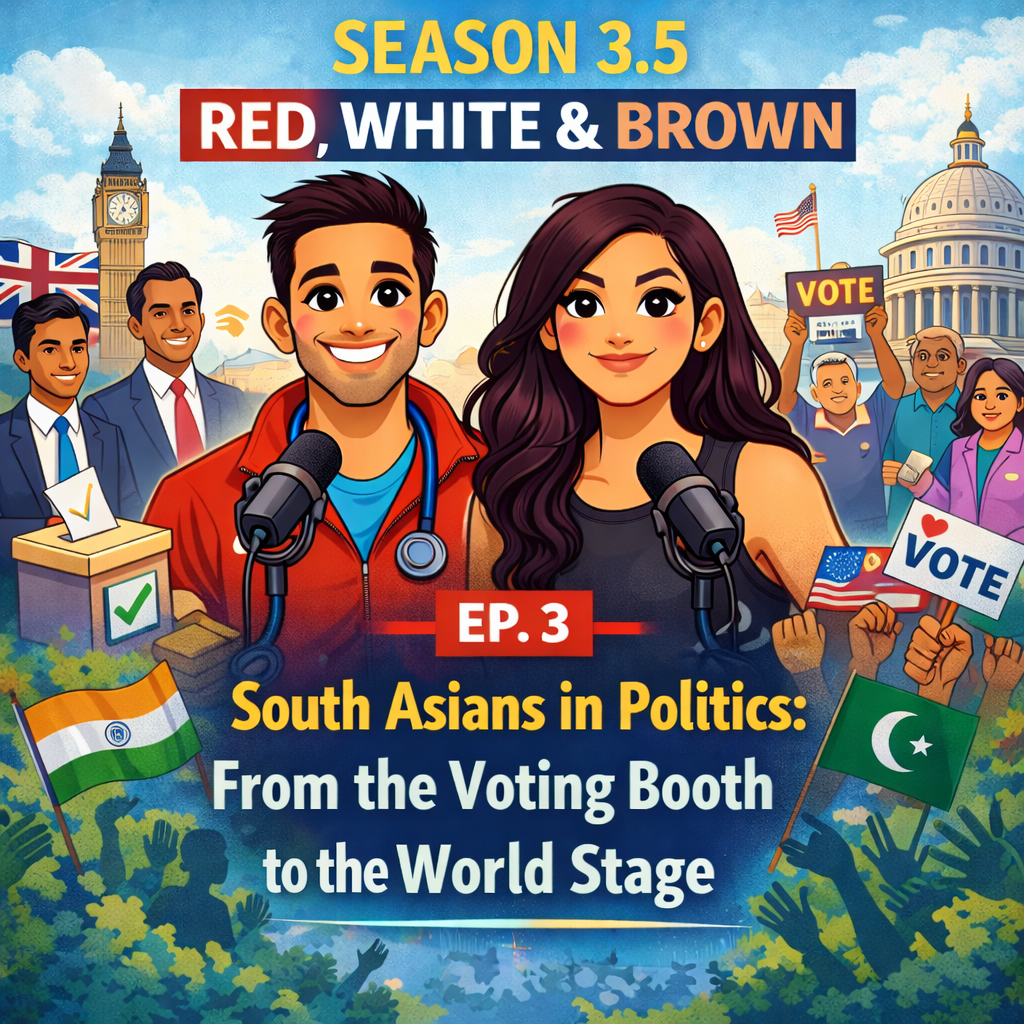
And I know this can be a tough topic regardless of where we fall on the spectrum, but the reason we wanted to bring this up is because there's a very interesting discussion that can be had about South Asians in politics, specifically since 2020, which is the last time we were on this podcast together. Sophia, I just feel like we've been seeing so much more South Asian involvement in politics, and I can't tell if that's just selection bias because we pay more attention to politics, or maybe it's time bias, given that, you know, South Asians and politics in this news cycle tends to be like a right now thing, especially in 2025. But regardless of why there is South Asian involvement, I think it's still very important to acknowledge, and I think there's a lot we can learn from this.
[00:01:17] Speaker B: Yeah. Since we last recorded, so much has changed. We have Usha Vance, who's the new second lady. I was about to say first lady, but I was like, wait, that's not right.
So we have Usha Vance, who is the new second lady. We have Zoran Mamdani, who is just elected as the mayor of New York and about to be sworn in at the time of this recording. We saw Vivek Ramaswamy, who put in a bid for the presidential election in 2024. We shot.
We saw Rishi Sunak, who won the election for Prime Minister in the UK in 2024. So it's actually crazy. Like, there's so many South Asian kind of rising politicians and just politics adjacent people who are. I don't know, it almost feels like, you know, taking over.
[00:02:04] Speaker A: And honestly, Sophia, we had an episode where we talked about South Asian CEOs, and now we have South Asian politicians. And it's pretty cool to see people with the last name Ramaswamy run for president. And honestly, if you had asked me if that was ever possible in third grade, I don't know if I would have believed you. And honestly, I don't even know if any of my teachers would have. And I will say that this isn't Just anecdotal, right. Like I read a lot of news now. And according to the New York Times, turnout among South Asian voters has increased 40% compared to the 2021 primary.
And this is based on a New York Times analysis of voter records and demographics based on their names and neighborhoods from a nonpartisan data firm. So let me ask you, Sophia, why do you think this is?
[00:02:47] Speaker B: I mean, you might know better than me, but my guess would be that as South Asians have been in the US longer and as sort of the basic needs are met and there's more breathing room to even think about voting in politics, that's kind of the cause for the increased turnout. I mean, it's no secret that those who are working long hours and those who have, you know, kind of non professional jobs, like, more like blue collar jobs are the ones who don't get to vote. Right. So election day is often a day off and in many states at a lot of banks and large companies. But for someone who's working in like a grocery store or drive the taxi, election days, it's just like any other day, right? You don't get a day off. And so as South Asian immigrants kind of move up the ranks and are working more white collar jobs versus blue collar jobs, maybe it's easier for them to have that, that turnout. I don't know if that makes sense but, but even aside from that, because this is just like anecdotal, but there are research studies showing that higher household income correlates with higher voter turnout. Right. So we can, we can link to those in the show notes, but just makes sense that as South Asians kind of move up the income brackets in the, in the US there's higher turnout. And then I also think Gen Z is a bit more political, whether because of social media access or whatever else. I do think they are part of the increased voter turnout themselves and then also encouraging family to vote. What do you think?
[00:04:14] Speaker A: I agree with that and I think one, there might just be more Gen Z South Asians because there's, you know, more generations of us. And I 100% agree that they seem to be more involved politically and all the more power to them. I have cousins, which I'm going to talk about later on in this episode, that are reading the news at the age of, you know, 10, 12. They have these endogenous curiosities because their parents have been much more involved in politics and so they themselves grew up much more involved. Whereas at least for me growing up, I wasn't even a citizen until 20 years in. And so I didn't learn about it. And so. But now if I had kids, they would be pretty involved and I would be able to teach them much more than my parents were.
[00:04:54] Speaker B: Yeah.
[00:04:55] Speaker A: So I think that's one question that I think deserves continuous thinking about. But that turnout is improving. But let me share another interesting point. More than 20 South Asian democratic candidates have unsuccessfully run for office over the last two decades. And so this is quite a large number. And perhaps this represents the growth in people like us, Sophia, like me and you, people who grew up in. In the states and finally are reaching an age where they can be active. And yet few politicians from either party have tried meaningfully to engage South Asian voters. So, for example, a 2022 Asian American voter survey has found that about 56% of respondents had no or uncertain contact to South Asian voters from democratic side, and 2/3 said the same of Republicans.
So what do you think the perspective is on this? And, like, why do you think engagement among the South Asian voter bloc seems to be not as evident as, for example, the voting block for, you know, rural, maybe white Americans in the Midwest, which is a different group.
[00:06:04] Speaker B: Okay. I want to say I'm shocked that it has been over 20 South Asian democratic candidates who have tried to run for office. I don't. I don't even think I could tell you, like, three.
[00:06:16] Speaker A: Yeah, right.
[00:06:17] Speaker B: Like, does that sound. Am I wrong here? Like, there were 20 South Asians who tried to run for office.
[00:06:22] Speaker A: Yeah. And this, I'm sure, includes Congress, maybe state legislatures, like, all of them. But I agree, like, it's. I. I know very few.
[00:06:30] Speaker B: Okay, fine. If it's, like, smaller races that are not in, you know, my state and stuff. Okay, fine. Maybe I believe that.
[00:06:36] Speaker A: Yeah.
[00:06:37] Speaker B: So I think we, as South Asians are not the majority. Right. In this country, and we never have been.
So that's part of it. Right. I think that's part of why we have not been appealed to South Asians. I had to look this up, but currently they make up less than 2% of the U.S. population, which is like, we're a smaller minority than actually, I thought I would have guessed maybe like 8 or 9%. But, you know, maybe part of that has to be. Has to do with living in New York. And then, you know, in. In med school, I think South Asians, you know, make up and in the hospital or.
Oh, yeah, exactly, exactly. So I think we're kind of seeing higher percentages in the circles that we're kind of running in. But South Asians are less than 2% of the US population. So that's part of why I think these politicians aren't maybe catering or engaging with the South Asian demographic. But I think the other key thing is that we historically have not held a lot wealth as a demographic. Right. Like there are obviously there are other demographics in the US who are also minorities, but do hold immense political power and lobbying power, but that just hasn't been us. And I think the other piece of that is that we have not been very good at organizing. Right. That's a key thing. And, and part of that might be because we ourselves are a little bit divided. I mean, South Asian American voters are not a monolith.
Some are Hindu, some are Muslim, some are higher socioeconomic status, some are lower. There's no easy way to like lump all these people into one group and appeal to them, right?
[00:08:21] Speaker A: Oh, totally. I think that's an excellent point, specifically because we all just come from such different backgrounds. And so I guess zooming back out, I also read this statement as like the statement about South Asian voters as just them not being thought about a lot in politics. And in a way I understand it. Right. I kind of mentioned to you earlier, I personally had nothing to do with politics growing up and honestly my parents didn't either because we couldn't vote. So according to what you just said about the monolith, I think within that monolith there's also a big chunk of that 2% who may not even be citizens. There's also that big chunk that may be citizens but have no idea. Right. About how exactly to vote and all of those basic things to get involved. And then there's probably a large chunk of that 2% which is now heavily increasing that are involved. They know what, they know that their vote matters, they know these key issues and all of those things. And so I think it's a gradient. But the interesting part about the gradient is that I think that gradient is shifting more and more towards hopefully more people being involved just because there's more of us, there's more likely third and fourth generation, these Americans.
So that's my, my take on it.
[00:09:35] Speaker B: You're absolutely right. I didn't even think about a part of that 2% is probably not documented.
[00:09:44] Speaker A: Yeah. And I, and I, and I speak to that part of the 2% because when I was a part of that 2%, I almost felt othered in a way. Right. Like those feelings still persist to this very day because I would see all of these things in the news cycle when I was growing up, obviously there would be headlines, there would be something that's coming on on tv, and it would almost feel like that doesn't apply to me. And then this comes up all the time in your life. Like, when you're applying to college, you always have to select, oh, I'm not a citizen. And then that brings up this whole extra page of questions. So all that say, all that to say when politicians are speaking about their voters and constituents, regardless of party, I never really felt like they were speaking on my behalf. And that has started to slowly change because now a lot of the decisions they make do me right. Like if they make a decision on student loans or if they make a decision on X, Y and Z and the types of taxes we have, we. We are going to have to pay those now as obviously citizens. And so that is something that's very important. And I think that is something that has recently started to change.
[00:10:47] Speaker B: I feel like this is such a interesting perspective. And even though PR and I are friends, like, we haven't actually talked about this before. So this is, you know, I really appreciate you sharing this perspective. And it makes so much sense when you say it like that, you know, feeling like, okay, I'm not a citizen, so these people aren't talking to me anyways.
And that makes sense. Even though politics, obviously, it does still affect you even if you're not a.
[00:11:13] Speaker A: Citizen, honestly, it might impact you more. Right. With everything that's going on, because there's gonna be very big changes that say, hey, this applies to citizens and this doesn't. And that impacts people who can come into the country, people who can stay in the country, and ultimately people who might be put out of the country. It's kind of crazy.
[00:11:30] Speaker B: Yeah. Yeah, absolutely.
[00:11:32] Speaker A: So let me. Let me talk one more thing. So, like, the other thing now that I think is causing me to be much more involved and you can tell me if you agree, and I'd love to hear about everyone listening is that now I'm seeing people that look like us, that have the last name Ramaswamy or maybe even the last name. I don't know what Ushavans last maiden name was, but even a woman named Usha, right in the second lady position. And that empowers me to realize, like, oh, my God, these conversations do impact me, or, wow, someone like me is saying this. And so it impacts them. So maybe it impacts me, too.
And I guess that also empowers me to say, oh, I guess I'm allowed to have an opinion on this, which I Don't know, maybe I just have a very low ego. But for the longest time, I was like, am I even allowed to have an opinion on this? Like, I don't know. I've never really been catered to. I've never been asked for my opinion. And now when I see these people say, oh, I feel like this and this. Vivek Ramaswamy just published an op ed in the New York Times about, you know, what he defined as an American.
And he defined an American as, like, someone who believes in the American values of democracy and free speech and not so much what your skin color is or what kind of ancestry you came from. And that just, like, really struck a chord with me because I think it's something that I think we often forget in this day and age. And again, I don't have any affiliation with any party when I'm speaking to this. It just made me reconsider what we consider is, as an American, I know it's kind of stupid to say, but I feel like I lived a large part of my life feeling like I wasn't allowed to have that opinion because we're immigrants, right? Like, we're new to this country. It's kind of like being the first new person at a party and then trying to take over. It just doesn't seem like the right thing you should be doing.
Do you feel that way? I know you technically grew up here, right? Like, you were always a citizen, so maybe you don't feel that way. And so my hypothesis about this might just be where born and ultimately our upbringings.
[00:13:25] Speaker B: Well, yeah, you're right. So I was born in the US and my parents became citizens, I think, before I was born, or maybe I was a baby. But, like, as far as I can remember, you know, they were always thankfully, you know, documented and had a legal status in this country. But part of that is because they arrived to the country earlier, and I think it was President Ronald Reagan that gave amnesty to people who were in the country illegally at that time. And so a lot of South Asians at that time did receive legal status, but that was, you know, if you arrived in, I don't know, the 80s.
So, yes, I grew up with, you know, my parents voting, and I do think politics matter a lot. You know, I feel like when I hear people say that they don't care about politics or they're not interested in politics, it makes me feel like either they're very, very privileged to be able to not care and to not be impacted by political decisions, or they are impacted, and they're just ignorant to that fact, and that's why they don't care. Yeah, but I think how you just said it, your perspective is something I didn't even like. I had never heard that perspective, so that's actually so fair. Like, I get why someone would feel like they're not allowed to have an opinion if they don't have legal status. Of course, I think you can still have an opinion and you're still allowed to care and you should care. But, yeah, I had a pretty different experience than you, but. But, yeah, thank you for sharing your perspective.
[00:14:54] Speaker A: Oh, of course.
I guess now I want to shift to second half of this conversation, which I think is really important also, because this podcast is about desi Americans, and I want to ask about the older generations, which is where we all come from. And the reason I want to ask this is because, I don't know, I think we all have a very interesting relationship with our elders and whether or not they're engaged with politics. And for those who aren't, I want to know what ways we can have to engage them further. So let me ask you, Sophia, are the majority of the people in your life involved in politics? So what I mean by this is, do they vote? Do they kind of read the news? Are they up to date on X, Y and Z?
What has your experience been in your family?
[00:15:39] Speaker B: So, yeah, as long as I can remember, my parents and my grandparents have always said that it's important to vote and that it's our civil duty.
I will say, as a Muslim family, like, some of our values are very communal and, like, rooted in social justice. And so my family is always, like, has always voted blue and is very in support of, like, social safety nets and improving the quality of life of everyone and yada, yada. And I remember from a very young age, my parents always telling me that, like, you shouldn't vote for someone just because they're South Asian and because they look like you, like, you have to vote for the Democrat.
You know how parents kind of, like, impart their political beliefs on their kids?
So, yeah, that was kind of always. Their. Their stance is, like, you have to look at the person's policies and pick the. The person. The candidate who has. You know, in our case, they would say you have to vote for the candidate who's Democratic, even if. Even if the Republican is South Asian and you think like, they look like you or their name sounds similar to yours, like, that's not a good reason to vote for them.
[00:16:43] Speaker A: Yeah, I think this is Something I also, in a way agree with. And I think it's because we are reaching a point. And I think to a certain extent, Sophia, you reached it a bit earlier than many of the others. But you, your parents were involved early, and as they were involved, they imparted their wisdom to you, and to a certain extent, that shaped your thinking. And now we are reaching places where people are third and fourth generation, Indian American, Muslim American. So to a certain extent, they're indoctrinated into this country and they actually feel fully empowered, which is amazing to be involved in politics. They're reading up on things. And I don't think I could have ever said this about myself when I was young, especially because there was cognitive dissonance of being not born here. But now, to a certain extent, everyone is born here. This is their home. And it's perfectly clear to them how they're involved in this country. I will give you an example that is so fascinating.
I have a lot of young cousins, but some of them actually read. Basically there's this thing called Time for Kids, which is literally Time magazine, but it's structured for kids, so it updates all of the most amazing news stories for kids. And they're so involved. Like, one of my cousins knows Pope Leo, who he was just like indoctrinated as the Pope. He knows what's going on with Russia and Ukraine. He knows what's going on, you know, in the Middle East. And it's just like fascinating to me how involved they are with all of these things. And I don't think I would have ever known that. But part of it is because they have parents that's, that are telling them about these things. And so when they have questions, they can get good answers and then they read these things and it's, it's fascinating to see these like 10, 12 year olds tell me about Zelensky and I'm like, dude, how do you know this guy? You know, like, it's so amazing to see their involvement.
[00:18:29] Speaker B: So that is so awesome. And honestly, good on your aunt and uncle for instilling that in them. Because there is so much junk media now, right? Like, I see kids even as a pediatrician, like, I'll see kids in the office scrolling on TikTok and like YouTube shorts especially.
And it's just there's so much just like junk media that don't help kids build any critical thinking skills. And so, you know, just encouraging them to be aware of what's happening in the world is such a good gift that your aunt and uncle are passing on to the kids.
[00:19:02] Speaker A: So I guess now we can just end with some big takeaways. Because, I mean, this goal, the goal of this podcast was to really show how politics has changed. Encourage, ideally, everyone who's listening to be a bit more involved in politics.
And I guess the big thing I want to end with is takeaways. Like, how can we get more out of politics? What are the things that we should be doing to stay involved? And ultimately, if we're kind of nervous to get our feet wet or maybe feel like our opinion doesn't matter, try to get you the right starting blocks to get involved. So, Sophia, what are your big takeaways?
[00:19:37] Speaker B: All right, so I have two big thoughts.
So one is that I think we as a community do need to work on organizing ourselves, right. If we. Political power, we have to act together and pick, you know, a couple things that we push for and really unite on that front.
You know, a fist is a lot stronger than five individual fingers. Right. So organization is key. And I think that's our biggest area for improvement. And we should be inspired and learn from other communities who we see who have a very strong political lobby and are able to fight for their community. You know, the challenge, as I mentioned, is that South Asian Americans are very diverse, and getting, what, everyone and getting everyone on the same page and on the same political agenda would be tough. I mean, you know, you hear, for example, I don't know if I should get too much into this, but, like, Zarna Garg was on this podcast, and, like, she and her daughter were talking about how much they admire Usha Vance. And so, I mean, a lot of the, Like, a lot of the Pakistani and Bangladeshi American community is not really going to be on board with that because they're, you know, typically not in support of Trump and. And his party, but. And I'm sure a lot of Indian Americans also don't agree with that. Right.
So it's. Yeah, it just goes to show, just because we all look alike, that doesn't mean we're all going to agree and be able to be united.
So that's. That's one. One thought, and then I have another one. But do you want to. Do you want to go first with your takeaway and then I'll share my second takeaway?
[00:21:18] Speaker A: Yeah, I never really thought about that idea of uniting between a few common themes, which I think is true, because even though we're all South Asian, I think we can agree on, like, maybe general, broad themes, at least one or two that we can all kind of push for yeah, and then we can still have diverse views on everything else. But I think for me, the biggest takeaway I've had is just how important current events can be. I remember being in med school, school, even, Sophia, and seeing a lot of our classmates, like, be reading the New York Times, and I was just like, oh, this is so silly. Why are they not studying medicine?
Like, why are they reading the news?
And I used to think, you know, it was just silly. It's just like, my time is wasted on this. And now as I've grown up, I'm just like, oh, I get it now. Like, it's finally starting to click because the world is all connected. You know, whatever happens in one place can affect others. What other big events happens, or any big decisions by people in power literally either impact us or they impact someone we know. We have literally now been through a government shutdown that could have ended food benefits. We've been through multiple wars that all could impact the United States. We've just been through a lot. And so if you don't know how it impacts you, either you're not reading enough or sometimes you're just not as aware. And that's bad, because you will realize the more you read, the more it does impact you.
Loan repayments, immigration sentiments, global politics, all have a direct bearing on us, whether we like it or not. And the more we learn about this, the more you see how much it will impact you.
So I guess my. My only ask is for anyone listening to this podcast, if you're already involved, great. If you can try to get one other person involved. Like, I just got my dad a New York Times subscription to a certain extent, to help. Help him read stuff just outside of what's going on in India. And I think that's one thing I would ask everyone else to do.
Subscription to their favorite medium for maybe someone they care and love, and then ideally get them to be voting in their elections, because I think you learn more and you realize, oh, wow, this impacts me. So that's. That's my biggest takeaway. I know you had one more, Sophia. What. What is your last one?
[00:23:26] Speaker B: I mean, it really ties into what you just said. And I think a lot of the push to get the older generation involved does come from the younger generations, right? Like us and even people younger than us and just pushing the older generation to vote. I think a lot of times that's just how social change happens in society, not just in desi families, but even, you know, even for, like, white and black Americans. The example that comes to mind, like, even in our community, when it comes to getting the older generation to be a bit less racist, which, let's be honest, a lot of older desis are pretty racist. And a lot of that work has to be done by our generation. Right. I feel like we, as the South Asians in the US have benefited so much from the civil rights movement, which was, of course, led by black Americans. And so, you know, I think we need to kind of learn and teach our older generations about sort of that U.S. history. And I know a lot of people aren't going to agree with me on this, but, like, I feel like we can't just divorce ourselves from the history. Right. Of what it means to be a colored person in this country. And so, like, our parents and grandparents, like, they didn't learn US History in school because they didn't grow up in the US So they. Unless they really do that work and learn on their own, like, they don't know a lot of this stuff. So I do think there is some weight of responsibility on the younger generation to kind of educate our parents and grandparents. And we might not be able to fully change them and change their views completely, but I do think Gen Z is a lot more aware of this type of stuff and is more politically active as well. So I echo your sentiments that our request to listeners would be to kind of try and get their parents and grandparents and stuff involved.
[00:25:18] Speaker A: Yeah. And now Spotify actually has this place where you can comment. So hopefully when this podcast comes out, we'd love to hear from all of you all, what are some of the hurdles you've seen? Ideally, what are some progress that you've been able to make with your parents or someone you care about in politics?
And as you share those stories, I'm sure we can all learn a thing or two from one another. And that was really the goal of this episode, which was to embrace the fact that South Asians are getting more involved, obviously, as ticket players in elections, but also ideally, encouraging all of us to be more involved as voters as well.
So with that, I wanted to thank everyone for listening, and I think we'll end the episode here. Anything else to add, Sophia?
[00:25:59] Speaker B: No, I think that's great. I mean, this is a tough topic, so hopefully we didn't offend anyone too much. Our intention is really just to, like, share our unique perspectives. I think that's pretty much it.
[00:26:09] Speaker A: Okay. All right, thanks, everyone. We'll see you in the next episode. Bye.
[00:26:13] Speaker B: Bye.