Episode Transcript
[00:00:00] Speaker A: Foreign.
[00:00:06] Speaker B: Brown, the podcast that discusses the interesting upbringing of desi Americans and what happens when the Western culture meets the Eastern world. I'm Pre.
[00:00:14] Speaker A: And I'm Sophia. And today we are trying something new. So Prak and I are going to recap some news stories from this week that are related to Desi Americans, and then we're going to go into some audience Q and A. And we definitely do want to hear from you guys on if you like this new format, whatever your thoughts are, let us know. And we may keep this style. We may change it up based on your feedback. So let us know. Okay, so let's jump right into it. Should I introduce the first story?
[00:00:41] Speaker B: Yeah, go for it. I'm excited to hear.
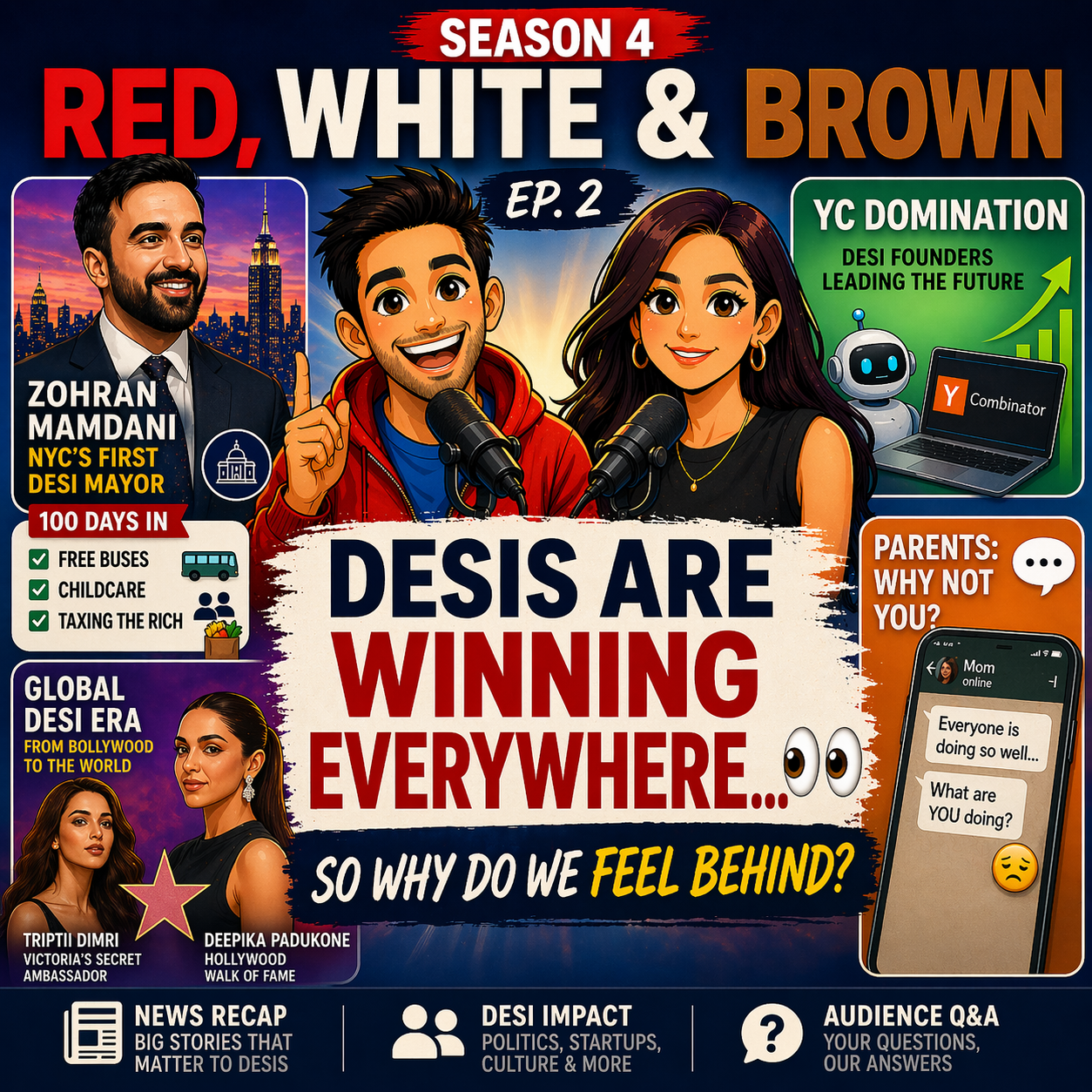
[00:00:43] Speaker A: Okay, so first story is that Zoran Mandani, who's New York's current mayor and first South Asian American mayor, marked his 100th day in office and there were a couple interviews that were published, Al Jazeera being one of them. I know you don't live in New York, Perak, but I'm sure you've still seen a little bit about him on social media or at least during his campaign. I know you did, but what do people seem to think about him in California, if anything, do people even talk about him at all? What do you think?
[00:01:14] Speaker B: Yeah, this is not surprising to me because the way he's talked about in California is going to be biased because California is a very liberal state. But regardless, I think the way he ran his campaign was already quite impressive to me. And a lot of the news outlets that I read that have been publishing about his first hundred days have actually been showing that he actually has walked the walk to a certain extent after he talked the talk. And I know that when he ran his campaign, he had these big promises that sounded almost inconceivable, but they were very, like, sticky, right? Like, he would talk about freezing the rent, childcare, free buses. And I can even remember that right now, even though his campaign's been well over and now he's actually going forward with it. I heard something about him making the city subsidized grocery stores. And then he's actually even like carrying out the taxing of the rich. And he's still pretty hefty on social media. Like, I'll say his social media game is insanely impressive. So I think the fact that he's hit his first hundred days is not entirely surprising. But I do think it's impressive that he's accomplished as much as he's accomplished despite his relatively young Age and the fact that he's actually like living up to his campaign promises, at least so far. How has the reception been in New York for you, Sophia? Because you're literally there with everyone who's basically his constituent.
[00:02:32] Speaker A: Yeah, it's super interesting. Part of it is I think I am a little bit in an echo chamber, at least on social media. And so it seems like everyone thinks he's doing a great job, myself included. He's getting stuff done. Like, even as simple as filling potholes, the city run grocery stores that he discussed are set to start opening. He talked about childcare and that is actually happening pre Rock. Like there's going to be subsidized 2K, so there's already something called 3K, which is basically when kids are three, they're in. It's not yet pre K, but it's. It's the year before that. And that is supposed to be available to all kids in the way that pre K and kindergarten, there's public schools. And so now they're expanding to 2k. So that's awesome. Right? Because that's one more year of public education that parents don't have to pay for privately. So it's cool. Right. Because for a lot of families for whom child care is a big part of their monthly expenses, like, this is actually going to make a big impact. The other thing, which I don't know if you've heard about, is there's going to be this tax on apartments that are second homes and that cost over $5 million. So that also feels. Yeah, yeah. It's called like pita terra. I'm not sure if I'm pronouncing it right, but it's like a second home. So people who own in New York, like apartments that are not like, they're not living in those apartments full time, and if that apartment costs over $5 million and they're going to be subject to a tax, which I think is pretty reasonable. Right?
[00:04:03] Speaker B: Yeah.
[00:04:04] Speaker A: You can afford a second apartment that you're not living in and it's over $5 million. Like you're doing pretty well for yourself.
[00:04:10] Speaker B: I saw that social media clip of him doing that or unveiling that tax. I think it's reasonable. I think with all of these things, though, I do agree that we're seeing one side of it. Right. If this person were to then suddenly liquidate their assets and move to a different state or the other thing I just checked is his Mamdani's approval rating is still 50, 40 to 50%, which I think for a politician is actually pretty good, but it does still show you that there is obviously going to be some level of discontent and the repercussions of some of these things will be yet to be seen. Jamie Dimon, who is the CEO of JPMorgan Chase, also has a lot of thoughts on what Mamdani is doing. And obviously there's going to be businesses that are for him and against him. But if you're going to raise the tax, I think a lot of businesses might slowly change their policies. So that'll be interesting. But overall it is impressive that he's carrying out this one main message of his campaign, which is the fact that I think the working class people should be the ones who should be catered towards and that the elite should probably help subsidize to a certain extent, certain things that are needed for all of society, which I think is the big thing.
[00:05:16] Speaker A: Yeah, I don't know if you also saw, but there is someone running for mayor in D.C. now, Rinni Sampat is her name and she, she's pretty young, she's 31 and she seems to be running on a similar platform to Mamdani, just talking about affordability and stuff. That's also pretty cool. I feel like now that he's done it, the floodgates are opening for other young people to run for office. South Asian and not.
[00:05:39] Speaker B: And I think he's redefining a lot of things, right? Like I'm like, the more I see him, I'm like, man, maybe we should have more South Asian politicians, right? This is just such a different way of governing and leading that I'm like, is it a South Asian thing or is it just the fact that he's so young and bringing all these ideas?
So amazing overall news. And Sophia, I wanted to pivot now to another story I came into more on the business side, but still related to South Asians. So this is about Y Combinator and one of the most recent news stories has shown that y Combinator's Winter 2026 Demo Day had a very strong showing of they see Americans and they see founders. And so I want to talk a bit about this, but before I do that, do you, Sophia, know what Y Combinator is? And then I will also explain it for everyone listening.
[00:06:24] Speaker A: I don't know too much about it, but I know it's a firm that basically gives money to startups and I know that the startups have to pitch themselves to Y Combinator. And I also know that it's really prestigious if you pitch to them, and they basically agree to give you funding if they sign off that your idea is a good one. I know it's a really big deal, but I don't know about who's allowed to pitch to it, exactly how competitive it is, how much money they give. I don't know, like, the details of it though.
[00:06:50] Speaker B: Yeah, that's basically. You got the general gist. But for anyone listening, the big takeaways of this story are that Y Combinator is an incubator in the Silicon Valley. It's based out of here, which is close to where I live. You go to them with an idea and they will give you certain amount of money for a small equity stake in your company. And in exchange, they also teach you how to build and scale a startup. Some of the most famous startups have gone through this. Airbnb is one, Doordash is another one.
And they just have a very good track record of scaling individuals. With that being said, the reason I wanted to focus on this story is because there's been a very large showing of Desi Americans who have been now selected and scaling their startups. And initially I think we've had a previous episode, Sophia ON DESI American CEOs and why there are so many of them. The reason I wanted to focus on this one is that it also shows now that this budding entrepreneurship of desi Americans not only goes to being a CEO, but even at the grassroots level and creating amazing startups. The one that I saw that was particularly interesting is called Pocket. It's literally like this recording device that you can stick on your phone and it records everything that's going on. So if you have a doctor's appointment or if you're on a phone call, it will literally just record it and create it like an AI generated summary of these things, which makes it easier for to keep track of different meetings that you attend. I think it's fascinating, but I think the bigger point I wanted to make is more importantly, like, South Asians are becoming American.
And I think part of this, part of our podcast has focused so much on like, never feeling like you're a part of either world. Like you're too South Asian to be American, but you're too American to be South Asian. But when you see people actually going and building stuff, building companies that are ultimately going to be serving our country, the United States, but more broadly the bigger community, it just shows you, like, okay, like we're not just South Asians or they seize. We're actually American all as well. And we're going to be creating these companies that work to benefit this, this country as well. So I think it's fascinating. We'll link this story in the show notes as well. I don't know if you have any other thoughts, Sophia.
[00:08:55] Speaker A: Yeah, I think it is really interesting just seeing South Asian Americans in the startup world. It's cool to see some of them really being successful. And I agree with you what you said, that it is so American. Right. I think when people think of America, they think of capitalism and all these different new ideas and businesses and research and new technologies and stuff. So definitely immigrants contribute to that for sure. What other? There were two other little headlines that came up. One silly but Tripti Demri becoming Victoria's Secrets first Indian Brand ambassador. Which obviously it's hard to say that this is so amazing and improving the lives of South Asian Americans or something, but it is cool to see Bollywood stars becoming globally recognized. And I think we're seeing this with East Asian celebrities as well. And while it feels maybe a little shallow or unimportant compared to everything else that's happening globally, I do think it's interesting in real time seeing South Asian stars become globally recognized. And there was one other thing too. Deepika Padukone is going to have a star on the Hollywood Walk of Fame in la.
[00:10:04] Speaker B: Wow.
[00:10:05] Speaker A: Yeah.
So she's the first Bollywood star to receive a star on the Walk of Fame, which I'm surprised by that, like Shahrukh Khan or Amitabh Bachchan or someone didn't already have a star. But I guess they didn't really do much Hollywood work. They pretty much were in Bollywood. And I guess, I mean, has Deepika
[00:10:22] Speaker B: done Hollywood work, though?
[00:10:24] Speaker A: Not much. Just there was this one, like, movie. It was called xxx. And I don't know, I feel like Bianca Chopra has done more in Hollywood.
[00:10:32] Speaker B: May that's what I was thinking. Priyanka sounds like much more American than Deepika, but that's so impressive that she's going to be the first one to get a star.
[00:10:40] Speaker A: I know. I don't know if it's just because maybe Deepika is like the bigger star globally, like at least now in Bollywood. Right. I would say Priyanka Chopra doesn't do much in Bollywood anymore. And so maybe Deepika is the bigger star in Bollywood and therefore the bigger star in the world in general. And so she's getting it. I don't know. But yeah, it is cool to kind of see them like get this global acclaim. And I love Deepika, so I am Very happy for her. She is my favorite. I'm like a huge fan of her.
[00:11:12] Speaker B: Yeah, I haven't watched any of her more recent movies, but yeah, she's definitely been one of those like people who 10, 10, 5 to 10 years ago was up and coming and now is a well established part of Bollywood. But I think both of these stories, though, more broadly is really nice to see. Daisy. Americans in different facets. Right. Like we talked initially, we started with politics, then we pivoted to business. Now we're more in like the entertainment aspect. And I think we obviously knew Bollywood in and of itself is fascinating but penetrating and entering other sectors, which is Hollywood and then more importantly, even businesses. Right. Like Victoria Secret. We've talked about colorism in the past. This aspect of making sure we're acknowledging that there are different types of skin colors and having people represent those on any stage can be very meaningful, not just for us, but for others that have similar upbringings and maybe different skin colors. So I think that's. These are big stories and I'm pretty impressed that you found them. So now I know these things.
[00:12:10] Speaker A: Yeah, I know. It's pretty cool. So should we pivot to listener questions? We have a few this week, so maybe.
[00:12:18] Speaker B: Yeah, let's do it.
[00:12:19] Speaker A: Should dive into those. So I'm going to read off the first one.
So this is from someone in Seattle who says, I'm a South Asian software engineer in my mid-30s. I'm working at a solid but unglamorous company and every time another Indian American crushes, he mentions like YC demo day and it goes viral in the desi WhatsApp groups. My parents ask why I'm not doing that. And basically he says the celebratory coverage feels like it's creating a new kind of pressure on him. And I guess it's not really a question he's just writing in saying this, but I can, I guess I can see how that's hard. Right?
[00:12:58] Speaker B: Yeah. I feel like with this question, people like Ravi are just like the epitome of what they see. Parents, why they can be so challenging. Like you can't win either way. Right. Like, we are told from a very early age to do doctor, engineer, lawyer, because those are epitome of low risk careers that have pretty decent returns if you want to think about it just objectively. And yet we all know the chances of a startup succeeding are minuscule. It's actually even more risky than, I don't know, like becoming an actor or actress. And those are care that notoriously they see parents are not going to look fondly upon, right? And yet you see these success stories and then it's like, you still lose. Oh, why aren't you doing that? Like, why can't you become mayor of New York City? When in reality it's like, hey, there's only one of those people and there's 99 to 100,000 that may not ever be in that position.
So it's honestly a win if you get it. And it's. It's a. You're just not winning. With desi parents, there's always something bigger, something better.
I think the most important part of what this question is getting at and I think is important is this acknowledgement that, hey, these feelings exist. They will almost always exist. And I think either we have to learn how to cope with them, whether that's understanding that what you're seeing is a very large amount of selection bias, right? Like, these people who become successful in startups, there is so much luck. There's also way more that goes into it than just, oh, they happen to be at the right place, right time.
But if by actually acknowledging that, I think we go a very long way and say, okay, just be okay with it. Know that they see parents make, just always say these things and that we have to be okay with the journey that we're taking and the decisions that we're making. Because honestly, I feel like there's no winning, even if you're. You have a stable job, from what I hear in this question, and yet you're still made to feel somewhat incompetent. And I think these are all feelings that we've all had, and I think the biggest thing is to acknowledge them.
[00:14:54] Speaker A: I agree.
Yeah, I agree. And also, like, to this guy, I would say if your parents are saying something like that to you, then if I were you, I would be like, okay, so are you gonna support me if I go and try to start this company? Like, I'd love to leave my stable job and do that, but I didn't think you would even be supportive and see what they say. Are your parents actually in support of you taking a risk, or is this just them kind of like, oh, why can't you do XYZ what it sounds like?
[00:15:27] Speaker B: Because just historically, like, a lot of the things that we see when they win YC Demo day, it's just not. It's not one day. They put in hundreds of thousands of potential hours into this one thing. And even then, there's people who do that and don't even make it to ycdemonae and this person just happens to. So what you're seeing is basically the tip of the iceberg, and you're being judged upon that. And I think that can be really challenging. So, yeah, if that's truly what we're comparing against, I think one thing is we educate our parents to be like, hey, this is just not realistic. And you are clearly not realizing that there's a lot of selection bias going on. And if they're still persistent on it, be like, hey, show them the other side of it. What if I don't make it and we're like a hundred thousand deep in the hole. Are you going to be okay with that? And that is. That's a really important thing to acknowledge.
[00:16:12] Speaker A: Yeah. And if your parents have a big appetite for risk and they would be supportive, then. Yeah. And if you have an idea of something you want to work on, like, sure. Talk to them about it if they're going to be really supportive, like, maybe this is a great opportunity for you. But I think when push comes to shove and you actually ask them, like, okay, I'm going to leave my job to work on this, like, how supportive are they really going to be? Or are they going to realize that, oh, hey, this is a huge financial risk. It probably is going to be all talking.
[00:16:42] Speaker B: Yeah. Speaking of talking, I'm going to pivot to the next question, which is a bit more about health. And I know a lot of our parents have a lot to say on health, so this question just says, I lost my dad to a heart attack at 54. He was a slim vegetarian engineer who did everything right, quotes, did everything right. Our whole family was blindsided. I've been reading a lot about South Asian cardiometabolic risk and how badly it's underreported and why our community struggles with this. Can you do a full episode and bring in a South Asian cardiologist?
Let me. I can start with this one, because the funny part is if I hadn't read this question, I would have thought that I could have said this and it would have applied. I mean, my. Luckily my dad is alive, but he also had a heart attack at the age, like, very young age. He is insanely slim. Like, he is the skinniest guy I know. He does mostly everything right. He still walks, he still, like, exercises.
And yet this guy got diagnosed with diabetes at the age of 21. As I said, he got heart disease pretty early. His dad passed from a heart attack pretty early.
So the big thing I'm going To tell you right now is South Asians and heart disease is very different than heart disease in general. I would love to do a future episode where we actually bring in a South Asian cardiologist and maybe we will do one because I know a lot of them. But all this to say, I also, as a physician, know enough about this that I can give you some off the bat recommendations.
We do not fit the stereotype of what a heart disease patient looks like. We have way more risk factors. And the problem with that is we don't often acknowledge those risk factors because they're not talked about enough. For example, we're not going to be traditionally obese, and yet many of us may still be pre diabetic. Many of us may not actually even know we have heart disease until we have the first heart attack because we often go undiagnosed for so long because the screening that we use is not catered towards South Asians. Right. Most people who get screened for heart disease are going to be people who are already diabetic, are already obese, already have signs of cardiometabolic distress. But if you then take those, like what defines those and apply those to a South Asian, they won't be relevant because a South Asian is not traditionally obese, but we still have a lot of visceral fat. And so all this to say the biggest and most important thing is to realize that being South Asian in and of itself can be a risk factor. And just because all of your labs say that things are normal may not necessarily mean that things are normal. For example, I am 30 years old. I run. I've run marathons before. I actually run pretty fast, and yet I'm already a pre diabetic. If you took that to any other person, that would be surprising. Like, that is a different nuance. Someone who's running marathons at a pretty elite level should not be pre diabetic. And yet I am. So this is in and of itself this thing where when I went to my doctor, I said, hey, I feel like my risk is above average. I know there's a lot of research coming out on South Asian heart disease, and I know that many of the guidelines do not apply to me. So how would you treat me? Knowing all of these stipulations and my specific family history, and just bringing this up to different doctors can be helpful because some of them are not even aware that South Asians have a different phenotype for heart disease. But if they are, they can then say, okay, this is really important. It seems like you're taking a vested interest in your health and they may actually recommend that you do things that other people may not. So for example, I'm on a statin and most people would not be on a statin if they were my age. And yet I am. And so these are where, this is where you really do have to meet your doctor, have very shared decision making, talk a bit about your heart history and make them realize, hey, this stuff is scary. And I feel like maybe I'm not being taken into consideration. I don't know if you've had experiences with this, Sophia, but I see this way too often and I think it's becoming more and more prominent as more and more South Asians are turning middle age and first generation.
[00:20:50] Speaker A: I fully agree with you and I think it would be helpful to have a South Asian physician too, because I think South Asian Americans tend to be more aware of this kind of thing just because we see it in our own families. And I would be curious on what the practices are actually in like India, Pakistan, Bangladesh, where physicians generally are probably, I think, more aware of the risk and the whole population is just at higher risk.
[00:21:20] Speaker B: I'm not sure. And I think the problem, again, I'm not sure what medicine looks like in India and Pakistan, but as far as I know, medicine historically has been way more reactive than it has been proactive. And so the problem is, even if they knew about these things, they probably are not treating it until the heart attacks already happen or someone's already like way past the point of treating prevention. And so I think the real value comes when you're this guy's age sending in this question. You're 30 and maybe you just had a family member who's impacted. That is where really medicine needs to come in. It doesn't need to come in when you've already had the heart attack. At that point you're dealing with 50 years of inertia. It needs to come in. And when you're 30 and you're like, oh shit, like I have a pretty bad family history, I should probably address this now. And that's what I did. I met with a cardiologist at the age of 25 and I'm like, hey, I'm not normal. Like, it's not normal to have a dad who's had a heart attack this young. It's also not normal for his dad to have had a heart attack at the age of 40. So whatever you're thinking applies to a normal 25 year old probably doesn't apply to me. And Then you add in the fact that I am South Asian. That is a very different risk modifier as well. And I think that's important to acknowledge.
[00:22:28] Speaker A: Is your cardiologist South Asian or no?
[00:22:32] Speaker B: Yeah, yeah, he is. And more importantly, there's actually a South Asian clinic at Stanford. It's called South. It's called Sati. It's like a South Asian heart institute.
So they actually only see South Asians because they know that a lot of these metrics don't apply to South Asians. Like anyone else who you would say, oh, you look normal and healthy. South Asia may not necessarily be the same because they just look different and their phenotype is different.
[00:22:57] Speaker A: That is so cool. And I feel like the research and the practices that are done at that clinic probably could be so helpful to physicians treating South Asian Americans outside of California.
[00:23:09] Speaker B: Definitely. And I'm hoping it'll slowly grow too, because I think, as I said, this is not a California only thing. And I think South Asians across the country and more broadly the world will need to realize that our risk is slightly different and make sure we advocate for ourselves.
[00:23:23] Speaker A: Oh, yeah, absolutely. Oh, I'm glad we talked about this. That's so cool. I had no idea that this SATI clinic was a thing.
[00:23:31] Speaker B: Yeah. And if you guys are ever in California, hit me up. I'm sure I can probably get you in. But it is, it's fascinating because even that has a pretty long wait too, because, like, obviously the Bay Area has a lot of South Asians, but people are realizing, like, oh, we need to probably be thinking about this a bit more deeply.
[00:23:46] Speaker A: That is so cool. And then. Okay, wait, we have one more question. I think we have time for one more. Let's try to get to it.
[00:23:52] Speaker B: Yeah, let's do it.
[00:23:53] Speaker A: So this one is from someone writing in from California saying that they are a child of immigrants and when they donate, they give mostly to black led and immigrant rights organizations here in America.
And his parents think that this is borderline disloyal.
And he is asking, is it true to say that our philanthropic responsibility is here and not like back home, quote unquote. And he's asking, where do we land on this? What do you think?
[00:24:26] Speaker B: Oh, wow, what a fascinating question. Yeah, I think this is so interesting because I have friends who have parents who are very patriotic to India, like insanely patriotic. Like they. But they live in America.
But I think where it stands for me is the person who I am is a combination of obviously my parents who have this patriotism to their land. Which is India, but also a large part of who we are, Sophia, is because of America and specifically the America that looked out for underprivileged people, right? So not the America that caters to the wealthy, not the America that is historically been catering to these people who have always been in power, but the America that said, hey, maybe we do need some immigrants, hey, maybe we do need to make room for diversity or maybe we do need to make room for these people who come from different experiences because we realize that is who we are. Like we are a melting pot.
And so I personally think if and when I have enough money to donate, I would be donating to a similar cause that this person is donating to. Whether that's immigrant led groups, minority led groups. Because these are the groups that we are sitting on the shoulders of, right? These are the groups that gave us.
When I was an undergrad, I got a scholarship from Leadership Association, I had a scholarship from PG&E that was all catered toward immigrants. And these are the things that we're basically standing on top of and that we wouldn't be here without. And so I think personally I'm like, hey, if I want to see more people like me and from my background be here, I would want to donate to that. Donating to India in my case is different, right? I've been to India, but I didn't grow up there, so I would. I feel much more confident about where I want to donate here because I know how that money is going to be used. Whereas if I were to donate to some random organization in India, I don't know, I don't know what community it's going to. I don't know how it's going to help people and I just feel way more distance to it from it. But if I donate to an organization that I myself have benefited from, that makes all the difference because I actually know where it's going and that makes me feel a bit more empowered. So that's where I sit. I think I have to balance who I feel like I am as a person and I don't think I deserve to be made feeling guilty for that. Even though I think our parents obviously have their own opinions and I think they can provide us with that. But that shouldn't govern entirely what we do. I think they can see that, hey, we respect your choices and here's what we're going to do. And if they really feel that strongly about donating, they should do it right. Like they should give to the subcontinent too at the end of the day I think they're just two different sides of the same coin. What are your thoughts?
[00:27:04] Speaker A: I do agree that I think as immigrants in the U.S. we are living the life that we have and we have the rights that we have partly because of those who came before us and fought for our rights. And obviously that includes the civil rights movement. And we're so indebted to the African American and Hispanic people who really fought hard for our rights. And so we have to take that into account. Right. Like the cultural context that we exist in when we are thinking about who we owe our help to. But I also think where we spend our money in general says something. And there's a part of me that thinks, yeah, you can all definitely donate to organizations in the subcontinent that are helping people. Absolutely think that's important and that's great and we should do some of that. But even just choosing to buy from South Asian businesses and support those businesses financially, even that is important. You know what I mean? If you have the opportunity to buy something from like Amazon or some big mass market company here in the US versus something artisanal, where more of the money is going into the pockets of people who are working on a craft in South Asia, I don't know if that makes any sense, but like, wherever there's an opportunity, I think to buy from businesses where more of that money is going to your beliefs.
Yeah, exactly like that.
[00:28:31] Speaker B: I don't know if you've heard about.
Do you know the CEO of Whole Foods? His name is John, John Mackey. He used to be the old CEO before Whole Foods got bought out. But the whole premise of Whole Foods is this thing about conscious capitalism. So I think that's the term that seems to encapsulate what you're saying. Sophia, you should not be you. You should realize that where you put your money is an indirect representation of what you believe in. And before John made this a big deal, like, there wasn't really a big movement behind it. But actually this is one of the biggest reasons why Whole Foods blew up. Right. Like, people were always like, why would I pay more for Whole Foods when I can get something cheaper? And if you're going purely off cost, then yeah, that's. That's true. Like, stuff is way cheaper outside of Whole Foods. But the reason why people then ended up going to Whole Foods is because of what it stood for. Whether that was non GMO treated plants products, the fact that it focuses on Whole Foods, quite literally. Right. Like, these are all fundamental things that he brought to the forefront and he was like, hey, if you truly believe in these values and you believe in Whole Foods and being healthy healthy, then you should be willing to pay a premium for it, because that's essentially what you're buying. You're not just buying this product, but you're buying these values that you stand for.
[00:29:42] Speaker A: Yeah, I think that's a good way to sum up what I was getting at. And I think what I'm trying to say to this listeners, it's not even just about donating. I think it's about where you spend your money in general. Right. And Whole Foods is a good example because there's a brand, it's called Dang, and they have these, like, Thai sweet, sticky mango rice crisp things. They're really good. And it was started by, like, a Thai family. And the snacks are delicious. And it's this, like, mom and pop company. You feel like you're not just giving money to this Nestle, huge organization that is run by machines and stuff like this. Feels like it's real people who are being helped by you supporting their business. They're bringing their culture to the mass market. And it's really cool. And all of this to say that I think whenever there's an opportunity to support a business who has values that align with yours, it's always good to take that, even though that is not donating specifically, if that makes sense.
[00:30:44] Speaker B: Yeah, totally. I think it's all about the values. And this is why businesses have missions too. Right? Like, when a business has a mission, they're not just putting out words. They're saying, this is what we stand for. And by buying this product, this is what you are also standing for. And directly.
[00:30:59] Speaker A: Yeah, absolutely.
So I think this is probably a good place to end it. We've talked for over 30 minutes now. You guys let us know if you liked this new structure. If you want us to change it up, we are very open to your guys's feedback. So DM us on Instagram, email us. We're here.
[00:31:18] Speaker B: And in the meantime, we'll be back hopefully soon with a similar episode and keep you updated on all things South Asian, news, news and Q and a. So thank you guys for being here. We'll see you all next week.
[00:31:27] Speaker A: Bye.
[00:31:28] Speaker B: Bye.