Episode Transcript
[00:00:00] Speaker A: Foreign.
Welcome to Red, White and Brown, the podcast that discusses the interesting upbringing of Desi American immigrants and what happens when the Eastern culture meets the Western world. I'm Pre Rak.
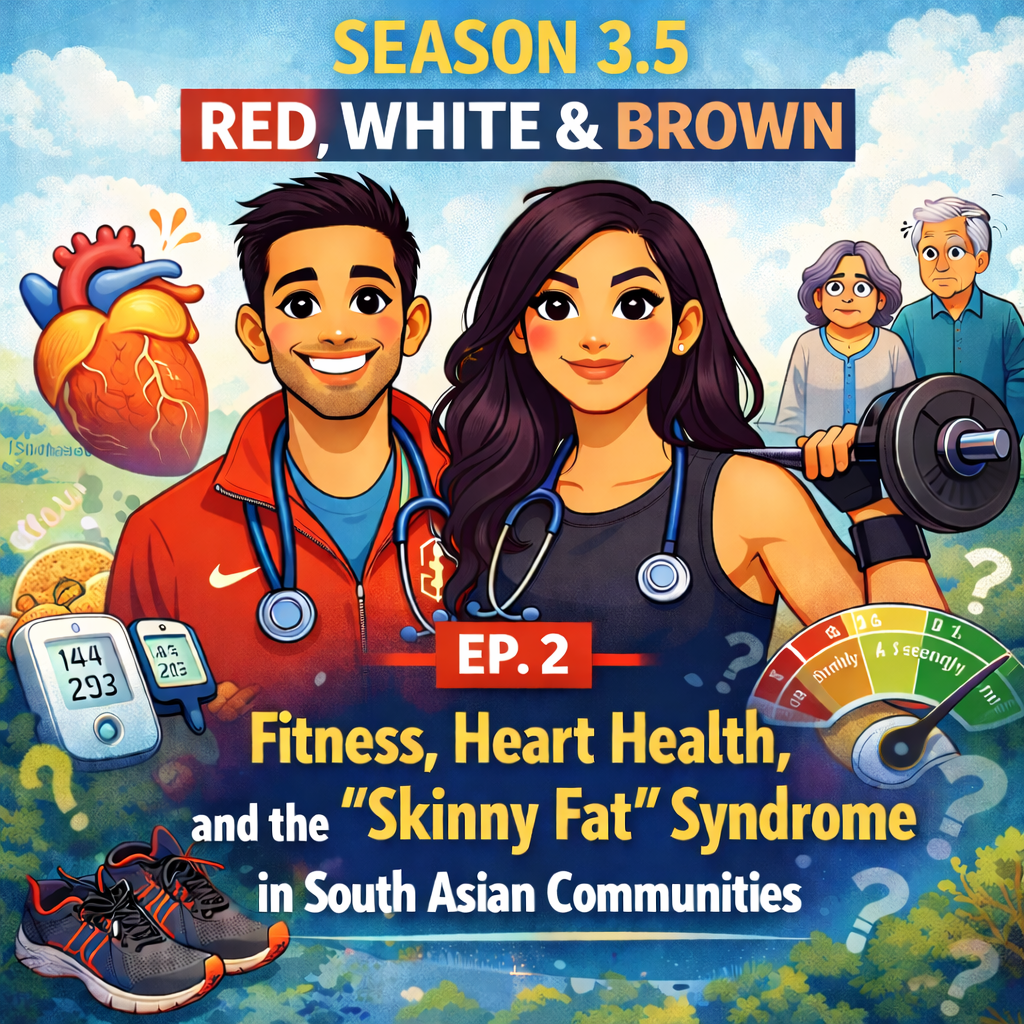
[00:00:14] Speaker B: And I'm Sophia. And today we are going to be talking about fitness as South Asian Americans. I know you guys are probably thinking that there are a million fitness podcasts out there. So, like, what could we possibly have to add here?
Why should we talk about this?
And to that, I think we have two reasons. So first, Priyak and I come from completely different fitness backgrounds, so we have two pretty different perspectives on fitness, which we'll share with you guys. And then second, most fitness content creators do fitness stuff full time. Right. We, on the other hand, were recently working 80 hour work weeks in residency, trying to squeeze in workouts and literally at midnight sometimes. So I think we have a pretty real world take on this and hopefully we have something interesting to add here.
[00:01:06] Speaker A: I totally agree. And of course we're going to put a South Asian lens on this and talk about why it's so relevant, not just as humans, but for the South Asian community. And I think this topic is particularly interesting because I have officially entered my 30s and Sophia is not too far off. So we're not really that.
[00:01:25] Speaker B: No, I am.
[00:01:25] Speaker A: Sophia is 30. She just turned 30.
[00:01:27] Speaker B: I just turned 30.
Oh my God, I can't believe that.
[00:01:30] Speaker A: I basically assumed that anyone who's not 30 yet, I just kind of put them in a different bucket. But anyway, I feel like when you're in your 20s, things just feel easier. Like your metabolism's higher, you have lots of things that you can keep up with, and health almost feels like a given. I mean, when we started this podcast, Sophia, we were both in our twenties. And also I just felt like things just came easier to me.
And so maybe this is residency talking, but now that I'm almost, Well, I am 31, almost 32, I feel that health just takes much more work and you have to put in like a definitive.
You actually have to, like, try to maintain your health. And I can't take it for granted. I see people all the time in the hospital who come in who are super healthy, and now they are not. And so that's one of the biggest reasons I think talking about this is important. Sophia, what about your relationship with exercise and fitness and, and how has it evolved over time? And then we can go into mine.
[00:02:25] Speaker B: Sure.
So I honestly did not grow up very active at all. My family was one of those, like, focus on school type families. So sports were not really encouraged, I will say. My dad actually did go to the gym every day, so the modeling of healthy behavior was there, but I was not even really allowed to, you know, do a sport after school just because the practices after school were seen as something that would take away time from my studies. And honestly, you know, it's not like I wanted to do any sports. I wasn't very athletic.
I was always a kid who was picked last in gym class because I was literally too weak to successfully participate in a sport.
So it's not like I wanted to do sports, and my parents didn't let me. I, um. But they also definitely didn't actively encourage it. And then college is kind of when things shifted and I began going to the gym and exercising more consistently. And then in med school, I started lifting weights, and that's really what, like, changed my body.
Not like weight loss or anything. I, you know, I was always pretty thin, but I finally built muscle and could actually, like, play a sport. For example, like Farzan's teaching me squash. And it is crazy to me to suddenly feel strong enough to be able to, like, hit the ball and keep up with him. It's like I had never experienced that before. So that's kind of my relationship with fitness and how it's evolved over time. How about you? I know your story is totally different from mine.
[00:04:03] Speaker A: Yeah. And I think I'm going to have to dig into your parents, which we will talk about a bit later. But having a father that was active, I think that's amazing. And maybe we can learn a lot from him, because a lot of South Asian parents are not like that.
And kind of like your story, I have a bit of a different perspective, which is from a very young age, exercise was my way of making friends. And so I realized that even though I didn't necessarily speak English all that well, because we came here when I was five or six, for me, exercise became the best way to connect with others. For others, it can be, you know, video games. Sometimes people bond over books, board games. But for me, it just happened that it ended up up being sports because it was something that I realized we could always talk about and bond over. So in elementary school, I started learning basketball. And even though I sucked, it allowed me to at least have a group of friends because we would all play at recess. And that was, like, a way to always ensure that I had something to do. And that allowed me to build bonds that I otherwise don't think I could have. And then from there, I went into middle school. But the problem is, in middle school, I was not good enough to make the basketball team. And so what ended up happening is I just did cross country. And so cross country didn't have any cuts. And similar to basketball, it was still a sport. And that created this form of community that, as I said, really became my way of making friends. And the rest has been history. So ever since then, I've been running.
And I actually got slowly better at it over time. And so that's one of the biggest reasons that I became active. And now I basically run every day almost, and it's become a staple of my life ever since.
[00:05:46] Speaker B: That is so awesome.
I know you didn't brag about this just now, so I'm gonna brag for you. But Prayerak is a marathoner. He's done multiple full and half marathons. So he's definitely a hardcore runner. And I know Faye, your wife, she also runs. Right. So seems like it's something you guys do together.
[00:06:06] Speaker A: Yeah. And it's become a very big form of community because, I don't know, we basically cross country was the original run club before run clubs became cool. And I think run clubs are really blowing up now all across the country.
And I think part of that is because of this theme. Right. Like, I think you can really bond over sports. And running is like the most primal sport. Like, we were doing this even when we didn't have basketball hoops or rugby courts. You can always run. And so when you run together and you run races, it really helps kind of form that community.
So I think next I want to talk a bit about our relationship with exercise.
What are your thoughts and where do we want to go from here?
[00:06:46] Speaker B: Well, I guess by we you mean South Asians as a group.
[00:06:51] Speaker A: Right, Exactly.
[00:06:53] Speaker B: So I'm going to let you dig into this a little more because you are the internal medicine doctor. I'm a pediatrician. For you guys listening. Priyak works in internal medicine. He works with adults.
But I'm going to say this, but I'm sure a lot of our listeners, listeners already know, but South Asians are at a lot higher risk for things like heart disease, diabetes, you know, higher risk than the average American. Right. Would you agree?
[00:07:20] Speaker A: Yes. And I think now that I've done three years of residency, I can tell you for a fact that South Asians don't look classically like the types of people that are advertised to get heart attacks. And yet they do. Right. So when you think about a classic person who might get a heart attack, especially in any sort of emergency department across the United States. If you took Indians out of the picture and Pakistanis and South Asians, you might think a person who's a little bit overweight, obese, maybe, has very high bad cholesterol LDL levels. On the other hand, though, if you look at a South Asian who gets a heart attack, they usually are not overweight, they're usually not obese, and actually most of the time their LDL levels, which is their bad cholesterol, is actually more normal. And if anything, they just have lower amounts of good cholesterol.
So this has been known as what's known as like the skinny fat syndrome. So South Asians tend to be much more skinny but still considered fat because they deposit a lot of fat around their visceral organs. And so this is one thing that I think we need to take seriously, because a lot of South Asians may not know this, but South Asians are at higher rates of heart disease. And if you actually look, we have a higher rate of diabetes, and that particularly we can hypothesize as to why that is. One could be our diet. Another thing could just be the way we don't exercise as we get older, but we have higher rates of diabetes. And then this leads to more and more amounts of insulin resistance, which then leads to more and more of this visceral fat deposition. And one thing I want to end on is if you look at any given bmi. So BMI is your weight in kilograms divided by your height squared in meters. If you look at any given bmi, you will see that South Asians have more body fat and a higher prevalence of metabolic syndrome, which is one of the biggest risk factors for heart disease, than their non Hispanic counterparts. And so what that tells you is, yes, we may look skinny, but if you compare yourself to someone else who is the same weight as you, who is not South Asian, they have a significantly lower rate of heart disease. And I can tell you this from personal experience. My dad has a BMI of like 20 and he has had two stents and a cardiac bypass by the age of 45. Right. So this is something to take very seriously, especially in our community. And all the more reason that we should be exercising.
[00:09:42] Speaker B: Absolutely. And I just want to say for anyone listening, so prayer said non Hispanics. So I think the reason he did that is because for a lot of these research studies and things, they will categorize people based on race or ethnicity.
And so for like standard white Americans who are non Hispanic, they'll call that demographic non Hispanic whites. And so basically what he's saying is that South Asian Americans have a lot higher prevalence of metabolic syndrome at any given BMI than like a standard white, non Hispanic American. Is that right? Would you agree with that?
[00:10:21] Speaker A: Exactly. Yeah. And I think it's just the way these research studies do these things where we group people based on non Hispanic whites, South Asian. And actually this has become so prevalent now that Stanford has its own South Asian heart Institute, it's called Sathi. And so that they, even Stanford as an institution recognizes that heart disease in South Asians looks very different than heart disease in any other group. And so because of that, they actually address it very differently.
So it's just all the more reason to talk about exercise.
[00:10:53] Speaker B: Yeah, no, that's, that's incredible. And basically the bottom line here is that we as South Asian Americans are at a lot higher risk for things like metabolic syndrome, heart disease, even if we look thin or we feel fine. Right. Like, you can't just go based off of, oh, like, you know, I don't look obese, so therefore I'm healthy. Right. It is still really important for us to try and live a healthy lifestyle because we, you know, unfortunately, we, you know, there's pros and cons to every culture and the genetic lottery. And this is just one thing that's kind of not our strong point.
[00:11:30] Speaker A: Right?
Yeah. And I think what you're alluding to is like one of the things is prevention. Right. An ounce of prevention is worth a pound of cure. And guess what? Heart disease, you don't really get a do over if it's a really bad heart attack. That's often, there's literally heart attacks that are known as widowmakers because by the time you have it, you're going to, you're going to die. And it's actually one of the biggest causes of death. And so to say, hey, I'll just worry about this when it happens. Well, when it happens, you don't really get a do over. My dad's dad passed away from a heart attack at 40 and that he didn't really get a do over for that. And so that's the problem with these things. They're very subliminal. And unfortunately with heart disease, it's often going to be recognized when it's too late, unlike other things like blood pressure and stuff. Right. Like, you can work on that over time, but heart disease, you can't.
So that's why I think this, this episode is particularly important. There's another saying where it's just the best Time to plant a tree was 10 years ago, but the second best time is now. And so just because we're talking about this now, it doesn't mean that, hey, you should have started exercising 10 years ago. Maybe start thinking about it now. And more importantly, start thinking about what you can do for your parents or other ones, other loved ones who are a bit older for you. So with that being said, Sophia, do you have any ways that you think that we can get our parents to be a bit more engaged with exercise and maybe get them involved? Because I really think that's where the heart of this conversation is. We're still in our 30s. I think we're making good decisions. But I worry about my parents and any South Asian's parents to get them a bit more active.
[00:13:02] Speaker B: Yeah, absolutely. So I will say we also have a lot of heart disease and diabetes in my family. I'm not going to share specifics, but I, like, trust me, my family is the same. Heart, Heart attacks at a young age. Everyone has diabetes.
It's so bad. Not. Not my parents, but, you know, aunts and uncles, like, who are not even that old, you know, Relatives.
[00:13:27] Speaker A: Yeah.
[00:13:28] Speaker B: So this is just so rampant in our community. But I will say, so there's a few things I think we could do.
I'm. Gonna. So I'm gonna share them with you and you give me your thoughts. Okay. So one thing that comes to mind is just that I think South Asian parents are very selfless. Like, if you ask them to do something for you, they will do it. But if you tell them to do something for themselves, you know, they don't really prioritize themselves necessarily. But so I think we kind of have to frame fitness as something that they are doing for us as their children, because it's gonna make our lives easier if we do not have to care for, you know, a physically sick parent. Right. So framing the discussion as, hey, look, like, you know, for me, for example, you know, I would tell my parents, kind of like, okay, I'm gonna have kids in a couple years, God willing.
It's going to be really hard for me. If you have a stroke and I'm a mom with, like, young kids, like, that's really going to throw things off. That's going to be financially very burdensome. That is going to be just a big headache. Right. That's going to be so stressful.
I need you to prevent that from happening, and you have to actively take steps to do that.
[00:14:42] Speaker A: Right.
[00:14:43] Speaker B: So kind of framing the discussion that way. So what do you think do you think that would be effective for, like, your parents or people that you know?
[00:14:49] Speaker A: I think it would 100% be effective. I actually never thought about phrasing it that way, but I don't think a single day goes by where my mom isn't telling me her deepest desire to be a grandma. And then before I got married, of course, it was like, her deepest desire to make sure both her kids got married. And so they're always focused on us. And so if we can frame it as, like, hey, you're not doing this just for you. Like, you know, a whole world revolves around you, so try your best to kind of address it, that might be helpful.
I will give it a shot. I will report back at some point to see.
I do think it does go a long way when you say, hey, this is going to help you see grandchildren, or, hey, this is going to help you potentially make it to my marriage, which I think is, like, really nice, because they can say, like, okay, I'm not just doing this for that. What other ideas are you thinking about?
[00:15:41] Speaker B: Well, I guess you and I are kind of in a lucky position of, like, we can actually use grandkids as a bargaining chip because we neither of us have kids yet.
So I feel like maybe that can be the second way is, like, if you're in that position, you could kind of be like, you know, you're not very physically active. I don't even think you're gonna be able to help me with grandkids, so I can just wait as long as I want. So if you actually want grandkids, maybe you need to get physically active and show me that you're even gonna be helpful. Otherwise, you know, I'm not in a rush.
[00:16:14] Speaker A: Exactly.
[00:16:14] Speaker B: Maybe that's one option.
Okay, another thing. So let me know what you think of this.
So I think a lot of people in our parents generation can be a little bit religious, like, usually more so than our generation, at least, whether that's Hindu or Muslim or. Or any other religion.
So I don't know, I feel like there could be a sense of appealing to the scriptures. And I think, like, Hinduism and Islam do have verses in their holy text that essentially say something to the effect of, like, your body is a gift from God, you have to take care of it, stuff like that.
Um, so, you know, if your parents kind of are religious and they have passed that down to you, you kind of can make a case of, hey, you're not really living by that value. Like, this is. This is really something that our religion Teaches us. So you're kind of being hypocritical by not doing this.
What do you think? Do you think that would work with people that, you know?
[00:17:11] Speaker A: Yeah. I have an interesting relationship with religion. I think it's like a double edged sword for me.
Not just personally, but also the way I think my family sometimes views it. I think appealing to that aspect is nice, but sometimes the other pushback I get, and I think it has some valid merit, which is, you know, religion also gives them this, hey, whatever is meant to happen will happen.
And in a way that's kind of a innately big part of religion. Right. It gives you this aspect to say, hey, some things are not in my control. And so I'm just going to leave it to this higher being.
And while that can be helpful for certain challenges, sometimes when you use that as like a hey, like, do you want to exercise? Like, this is something that, you know, we should not take for granted. I get the pushback at times about, hey, whatever will happen, will happen and I'm going to trust that it will be for the better and I'll try my best to exercise. But you know, if it's not meant to be or if I can't do it, then it's fine. And so that, that always puts me at a loss as to what I should even say next because in a way it's very logical. And I don't want to say like, oh no, that's, that's silly. Like, you control everything because you clearly don't. Like, we, there is a lot of stuff out of our control and I think the real power of religion is, is being okay with that.
So I don't know if you have any, any insights into that or if that's something you've gotten, but I do. I've never phrased it as like, hey, your body is a gift for God from God. I do think that is 100% true. And I do think the fact that it ever works is miraculous in and of itself because you and I both see the number of ways it can go wrong. So I'll definitely try to phrase it that way too.
[00:18:55] Speaker B: Yeah, absolutely. I mean, I think in Islam, like, I think that would work for some people.
And I agree with you, like, religion does give people this thing to fall back on of like, okay, whatever is meant to happen is going to happen. Like fake Ismail, all these things.
But I also think like, so like in Islam there's this hadith that is a kind of something that the prophet said. So there's One. It's kind of funny. It's like a man was asking the prophet, should I tie my camel to, like, to the post, or should I leave her untied and just trust in God? Like, trust that God is going to kind of, like, take care of it. And the prophet is like, trust in God, but tie your camel too. Right? Like, yes, like, there is, you know, maybe this. There's only so much that we can control, right? Of course, like, the whole universe is not in our control, but that doesn't mean that you don't do your part, right?
So that's kind of my response to the. To the fate. Like, you know, the fate, like, whatever's meant to happen is gonna happen type type thing.
[00:19:55] Speaker A: That's. I like that. I like that anecdote. That's a really good one because, yeah, you can't just say, like, oh, whatever will happen, will happen, and walk into oncoming traffic. You know, that's like. That's. That's a good. That's a good way to put it.
[00:20:06] Speaker B: So that was one.
That was one thing. And then what else did I have?
I guess, like, if you know someone in the family who's had a health scare, right? Or someone in your friend circle or whatever, I guess you could kind of use that moment to scare your parents, essentially. So basically I'm saying, like, we need to use some scare tactics.
You know, you kind of can be like, hey, look, like, this heart attack or stroke or whatever can happen to anyone and this person, right? Like, my friend's mom didn't plan to have a heart attack, but this can easily happen to anyone. You could be next also just kind of painting a really bad picture of, like, whatever happened to that person, right? Like, oh, my friend was telling me it's so hard after her mom had a heart attack.
The whole family is so depressed. Like, the mom needs a lot of physical therapy. She can't even walk up the stairs. She can't even shower herself.
They have to have, like, a home health aid. Like, just kind of, like, really paint the picture of, like, what happens, right, When. When someone kind of gets really sick like that.
I don't know. Maybe this is unethical and I'm basically saying to use scare tactics, but I think that sometimes that is effective with desi parents.
[00:21:28] Speaker A: Nothing is unethical when it comes to desi parents. I mean, I think that desi parents are the original inventors of scare tactics. Are you kidding me? My mom.
My mom. The problem with using a scare tactic against my mom is that she's going to know exactly what I'm doing. But I think, for the most part, I think it works. I do think that will work to a point. But, like, with everything in life, I found that it's very easy to get habituated. Right? Like, we've all had cases where a loved one is damaged and it affects all of us, and we. We take a moment to just appreciate and come together to help that person, but appreciate, like, all the ways that the things could go wrong. So I think these scare tactics might initially push someone to do something, but I think the hard part is what will maintain that.
So it might be like, okay, I'm going to try to exercise. And I've seen my personal family work maybe a week, two weeks, maybe a month. But the problem is after a month, it's so easy to get back into the same cycle of, oh, I did it for a month. Like, life's getting very busy. I don't have time for it.
So I have personally found that if we can get someone involved, this is where I found this aspect of gamification to be very helpful, or even just what I mean by gamification is creating specific goals that once someone is in exercise, you have ways to keep them engaged with it. So one thing could be like an app, like Strava. There are other also other apps like Personify Health, they give you little points, and Strava even allows you to set up weekly goals. So, like, your goal is to do 25 miles of running this week. And. Or you can even start small, like five miles, six miles. And by having something that's kind of implicitly keeping you accountable, I think you can stick to it much longer.
And I've also found, personally, because I do a lot more cardio, signing up for something can be helpful, too. So it's like, okay, say you have this stimulus, or you were able to engage someone and say, okay, you should exercise more. Maybe they're like, okay, I'll take it seriously. And they start. Maybe the next step then is to sign up for a 10k race in six months or even six weeks. And that way now they're not just doing it for one month. They actually have something that they know they have signed up for. And I have personally found this to work for me. And it worked really well in residency where I would just sign up for a race. And I knew that it was going to happen in six months, so I knew I had to plan for it because I could just show up without training. So that that's something That I think could work. Your scare tactics could work to get someone kind of engaged and then we just have to find a way to get it to stick.
So I like that. What other ideas do you have?
[00:24:06] Speaker B: Well, I completely agree with you. I do think the gamification is a big thing. And I didn't, I didn't think of this before, but kind of in line with what you said. Just try to make things fun.
[00:24:15] Speaker A: Right.
[00:24:15] Speaker B: So you know, your parents might not like going to the gym, but like could you get them to do some like garba or Bhangra or like Bollywood based workout videos in the living room? Because that exists, right?
There is. Yeah, yeah. So like there's a lot of joy in our cultural dances and those things can be the cardio that they need too. Right. So you kind of do have to treat your parents generation like as if they're kids. Right. And you're trying to make something fun for them. Because I mean, I think we all know this, but as people get older, like in some ways they do regress a little bit. You know, like a really old person and a child are not actually that dissimilar. Right.
[00:24:58] Speaker A: You don't, you don't have to tell me.
I 100% like a lot of the people we take care of in the hospital after 80s and 90s, which again, I don't think any of our parents fall into right now. But I agree with you. There is this regression that can occur that you have to, that you actually can prevent if you exercise. Because a lot of the most impeccable 80 and 90 year olds I've met in my primary care clinic are the ones that are still walking two miles a day. They're still doing aqua therapy. There's still people who are doing a lot of yoga and Zumba. So it's pretty impressive how these things compound over time.
[00:25:32] Speaker B: Yeah, absolutely.
[00:25:35] Speaker A: One thing I wanted to talk to you, selfishly, Sophia, is another part of this conversation. So fitness is definitely one thing where you have to work out. But I think part of fitness also important, engages what you're putting into your body. Right. Because that is a huge part of the equation, including combating heart disease. The one of the first things I would tell any patient who isn't exercising is, hey, what sort of diet are you eating? If they're high, having high blood pressure. So how have you approached your eating habits to balance fitness? If you have? Because I personally haven't.
[00:26:11] Speaker B: Well, I have done a lot of diets in my.
Unfortunately I will say the. I have felt my Best when focusing on whole foods. So just ensuring I get enough protein and then focusing on, like, whole fruits, vegetables, you know, nothing processed. I think that's the best way to actually feel full and satiated and enjoy your meals and not overdo it on calories. And I think once you're in the habit of eating whole foods, you start to dislike processed foods a little bit.
That, I would say, is the. The thing that I try to stick to. Like, am I successful all the time? Absolutely not. When I was studying for boards, I definitely was consuming a lot of processed foods. But I am trying to, you know, just use, like, apples as, you know, like sliced apples and almond butter as a snack rather than like a protein bar, like, things like that. Just trying to always shift towards any sort of whole foods, I think, is it's just always going to be better.
[00:27:14] Speaker A: For you and just for anyone who is like me. Define whole food more broadly because I guess I'm confused. Like, if you buy all these vegetables, how do you know which ones are processed and which ones are not? Because I feel like we live in an era where anything can be treated with things, even if they're supposedly a vegetable. And then also, how do you then consume the whole foods? Are you mostly cooking at home?
Are you going to specific restaurants that, you know, only have certain types of ingredients? Like, how do you even, like, cater to that? I think that's my biggest challenge because I don't know what exactly a whole food is, per se.
[00:27:52] Speaker B: Well, okay, so there's. There's like this diet called hold 30. I don't know if you're thinking of that or getting mixed up with that. But when I say whole foods, I just mean, like, foods that do not come in a plastic packaging, basically. So, like, fruits, vegetables, you know, milk, yogurt, cheese is kind of processed. But I think that's generally, like, I still consider that a whole food. Grains also are fine, like rice, wheat, oatmeal, stuff like that. But then like something like a granola bar, a protein bar, obviously, like chips, cookies, like, all that stuff. But I'm thinking more like things that have preservatives in them and have, like a really long shelf life and don't go bad for months and months. Like, I guess that's what I'm thinking of. And then I do cook, but I'll be honest, I do not cook every day or for every meal. I'm trying to cook twice a week. And then, you know, we will eat leftovers for a day after. So maybe like four to five Dinners in the week would be home cooked, and then we do eat out, and then for snacks and stuff. I'm really trying to have kind of more whole food options. So I kind of mentioned, I don't know, like, apples and almond butter, like those mini bell peppers, like yogurt and berries, things like that. Right. That's gonna be, I think, just a lot more satiating. And you feel better eating those things versus, you know, like, I mentioned a granola bar or anything, Anything that comes out of a plastic bag.
[00:29:25] Speaker A: I guess the. What you're alluding to is, like, one of the things I struggle with the most is, like, fighting the urge. And it's nice for you. It's nice for me to hear that. It seems like you feel better after you've eaten them consistently, because I don't think I've ever eaten them consistently. And I think I. I will admit my dietary. My dietary choices are not ideal and definitely not something that anyone should follow, because I eat a lot of carbs. And I also grew up vegetarian, so that limits a lot of what I could achieve. And that's not to say I don't think I can eat healthier now. It's just, like, limited my options growing up.
I see you clearly doing a great job overall with the types of foods, and it seems like you've experimented with a lot of diets.
And I guess my biggest thing is it's hard for me to eat a salad when I can eat Mac and cheese or a slice of pizza, or even cooking at home when I'm so tired and I can get a prepared meal somewhere else. That may not be the best for much less time.
So, yeah, I don't know what your personal challenges have been, eating healthy and then how you have combated it.
[00:30:33] Speaker B: So that's really flattering that you think I'm doing a good job with diet, because I definitely feel like I have a long way to go. I have a massive sweet tooth, and that's honestly my biggest challenge. So the last few months, Farzanna and I have been a little bit better about not bringing desserts into the home. And that's been a really good change, and that's something we definitely need to continue because prior to this, we were definitely getting, like, cakes from Whole Foods, and there's this ice cream shop that we really like in New York, so we would get, like, two pints of that every weekend. And all of that really just adds up. Right.
If you don't want to eat something, the key is just to not bring it into the house. Right. Because it's really hard to exercise the discipline to only eat a small amount or to not eat it if it's there. Right. A lot of these temptation things are just so hard to avoid because they're, they're so convenient. Right. That's why they keep candy in the checkout aisle. I've just realized I have to make it very convenient to eat healthy and I have to make it inconvenient to eat unhealthy. If I have cookies in the house, I'm definitely going to eat them. But I don't go and bake cookies every night. Right. So it's, it's all about convenience. And, and I say this like, oh, I'm. I'm addicted to sugar. I have a sweet tooth. But like, I'm not addicted to sugar. Right. I don't go and eat spoonfuls of white sugar. Right. It's these highly.
Yeah, it's, it's just these highly palatable, highly convenient foods that we're addicted to. But if you don't keep them around, you really can start to break free from them. Like, it's. It's probably been two months that we haven't brought any cake from Whole Foods into the home and stuff. And I don't even think about it anymore. But before, when we were in the habit of getting it every week or multiple times a week, it's like I would constantly be thinking about it. So you can start to break free.
[00:32:28] Speaker A: In my experience, I think the Fae has been teaching me that too.
My now wife, she makes it very challenging or she wants us to only buy things that we will either prepare or that are going to be things that are very easy to eat. And not buying a lot of the fast food, because what I've realized is the moment it's in the house, it's very hard to avoid it. But if you create barriers, then it's very challenging to actually consume it. I think the United States particularly and the South Asian diet put on top of that create a very inopportune combination.
But, but I think there are ways that we can combat it. So that's really helpful to hear your tips and I'll let you know how it goes.
[00:33:10] Speaker B: It sounds like Faye has a good idea of like, what to do and stuff. So I'm glad you're in her hands for regarding food.
[00:33:20] Speaker A: She is so healthy. She is so healthy. I don't know how she's done it, but she loves salads. Like, will go out to eat and she will order a Salad. And then similarly she will, anytime we're at my parents house, she usually is always eating like the veggies first and then eating everything else after, which is so not what anyone in my family is used to. But I think kind of like what you said, she has like trained herself where she doesn't like processed foods. Like it doesn't sit well with her. She doesn't like that. Like, why does this thing not go bad for a year? Like what's in this?
You know, so like she has taught me to pick up on these things. And I'm like, you're right. Like why does this not go bad after a year? Like, clearly something's in this that I probably, probably should not be eating because what if it won't exit my body for a year?
So so many nuances here.
I guess we can end because we started with fitness by asking about the most challenging part about fitness for you and how you have worked to overcome it and where, what it means for you in the future.
[00:34:21] Speaker B: I guess for me right now it is feeling like by the time I get home from work, there's only a few hours left before I need to get in bed. Like by the time I get home it's usually 7 o' clock.
And I ideally want to sleep by 10 because I wake up at 6. And so, you know, you have about three hours to like work out, shower, cook, eat, you know, if you have any, like little errands to run or things to do around the house. Like if I get home and I waste 20 minutes, then like my window to exercise is gone basically because then Farzan's coming home, like I have to warm up, food, all this stuff. So I definitely feel like that's the most challenging part for me. And it was even worse in residency because now, you know, like at least I actually have weekends. And I have one day during the week that I'm off. And so I have three days that I can definitely exercise no matter what.
So I shouldn't even complain. But that's kind of my biggest challenge right now is just how tight my schedule has to be and how efficient I really have to be if I want to get it done. But I do think that that is something that is going to become more and more challenging even like once I have kids and things like that. So, you know, just trying to figure out a way to, a way to balance it all. How about you?
[00:35:40] Speaker A: Yeah, I think the hardest part is always getting started.
I think anytime I want to go on a run, I think 100% of the time, I don't want to do it the whole day. And then the moment you take that first step, you just realize, like, oh, okay, once I've taken that first step, I just have to now work through it. And with every step, you kind of get stronger. And by the end, there have. There has rarely been a time where I end a workout feeling less or worse than I did before I started. And so I think one thing I always do is make myself realize that it is essentially an antidepressant, in my opinion. Like, you just feel so much better when you get outside, but it has an activation energy. And so you kind of have to know that you're going to have to overcome it in some way, shape, or form. And I think your aspect of making it as easy as possible is something that has worked wonders for me. Anytime I go to work and I know it's going to be a long day, I bring my running shoes with me, and I also bring a change of clothes, and I just change right after work and do it because I know the moment I go home, I'm going to pass out on my sofa or there's going to be something else. And by reducing that friction, it makes it so much easier. And I said, as I said earlier, too, like, signing up for things, even if it's just a simple event you want to do with your friends, or a friendly game of basketball or a friendly game of capture the flag, these are all things that I think can hold us accountable. And they also create this network effect because other people know your plan, too.
So I think that kind of wraps up all of my big thoughts on this. I feel amazed that we had so many nuanced conversations because we. We have such different backgrounds.
I don't think there's anything else I have to add. What about you, Sophia?
[00:37:21] Speaker B: No, I think this was good. And I think we're gonna probably continue to have conversations about this topic throughout the future seasons is my guess.
This is a good starter episode on fitness. We'll be back to revisit this.
[00:37:34] Speaker A: Definitely.
Yes. Thank you guys so much for listening, and we'll see you all in the next one. Bye.
[00:37:41] Speaker B: Bye.