Episode Transcript
[00:00:05] Speaker A: Welcome to Red, White, and Brown, the podcast that discusses the interesting upbringing of Desi American immigrants and what happens when Eastern culture meets the Western world. I'm Pre Rock.
[00:00:15] Speaker B: And I'm Sophia. Wow, we are back.
Back from the dead after three years.
[00:00:21] Speaker A: Hope everyone's had a good three years off. Honestly, so much has happened, but in a very real sense, some of the foundations of what this show means to us stay very much the same.
Sophia and I were able to stay in touch, and we continue to reminisce about this amazing Red, White, and brown community while also somehow trying our best to get through residency. It was a journey, and I'm sure we're gonna unpack a ton of it in the next few episodes. But before we get to that, Sophia, do you wanna briefly go over our inspiration to start Red, White and Brown when we started it over five years ago and ultimately why we took such a long break?
[00:00:59] Speaker B: Yeah. So for anyone who is still listening, we initially started this show as a way to talk about, you know, anything and everything related to being South Asian American. So we talked about TV shows like, never have I ever. We talked about the pressure to go into the medical field as Desi Americans. We spoke about how diet is a huge issue in our community. Literally anything related to being Desi American, and that's still going to be the case going forward.
But we did have to take a break while we were both in residency, which is the next step in medical training after medical school for those who might not know.
And we were both on opposite coasts of the US Myself in New York and Prayer Rock in California. But the geographical difference, I think, wasn't even the biggest issue. It was the lack of free time that, unfortunately, is the reality in medical residency. But we survived.
We're back, and we are hoping to resume the show.
[00:01:53] Speaker A: Definitely we're back for good. This time around, we're armed with much more time, thankfully, a bit more money, thank God, and hopefully even more content for longer time to come. With that being said, let's get into it.
Okay, Sophia. So despite the hiatus, we are actually now entering season four of this podcast.
That is amazing, and it comes with a lot of responsibility. I think we want to stay true to our roots of talking about the Desi American experience, but. But we also want to change a few things and help ensure we have a consistent experience for everyone who's still listening. So, Sophia, you and I talked a bit about this, but can you speak a bit about your goals for this podcast in the upcoming seasons?
[00:02:38] Speaker B: So my goal is really for this show to be really fun, something that listeners look forward to week after week. I want us to be entertaining and sort of educational, too, but mostly just be here to yap. And I want there to be a little bit more audience connection. So I'm hoping for more episodes where people write in for advice, we answer listener questions, things like that. And for this season, season four, you guys will see that we dropped four episodes at once. And then we're gonna be going forward with once weekly episodes. That's our plan. So what is your goal for the podcast, Prerok?
[00:03:11] Speaker A: My goal is very similar. I want this to be a place where all desi Americans will. Whether you're first, generation, second doesn't matter. But you can come here to discuss our unique upbringings and also discuss issues that affect our lives day to day. We don't have to all agree on everything, but I think the goal is to foster discussion in a community of people who have very similar experiences, because I think active discussion fosters positive change.
[00:03:37] Speaker B: Okay, so what has been going on for the last three years? Just quick recap. Obviously, we were both heads down working hard in residency, just trying to survive. Myself at NYU in pediatrics and yourself at Stanford in internal medicine. But what else? What's been going on?
[00:03:54] Speaker A: Honestly, I don't even think there's anything else in my life aside from residency the last three years. I think implicit in starting residency was the move. I know you were lucky enough to stay on the east coast, but, you know, you get matched and then you also have to, like, go to that area. And so for me, moving back to the west coast was nice because I was lucky enough to go back home. And then on top of that, I was also lucky enough to have met, like, an amazing person when I was in business school at Yale. And Sophia, I think you met her right before we, like, departed into residency.
[00:04:29] Speaker B: Yeah.
[00:04:29] Speaker A: And so she moved in with me. Our relationship was pretty young when we first moved, but I knew pretty early on that we had something special. And so she. She supported me through residency. And I think the crazy part is when someone is able to stick with you through an experience like that, you really. It really shows you the. The strength of that commitment. And so it made me realize just how grateful I was. And so for all those reasons and many more, I knew she was my person. And so at the end of residency, in July of basically 2025, we also ended up getting married. So not just residency, but also marriage.
And then it was a lot to try and get that done with residency. Happening. But we're so happy that we could ultimately celebrate with everyone. You and Farzan were there, so that was amazing. And then the other small thing that happened, which I guess is technically a big thing, is that we also got a dog.
So we've had a dog now for almost three, four years, and he's like the biggest part of our life. So that's been a huge change.
What about you, Sophia? What have you been up to the last three years? What big changes?
[00:05:34] Speaker B: Well, that is so awesome. You did so much. I feel like getting married is a huge thing. Like that in itself feels like such a big life change.
So for me, compared to you, I feel like I haven't done anything huge.
I. I got married before residency, as, as you guys might know for our listeners, but Farzan and I fortunately have a very thriving social life. We feel very grateful for that. I feel like I had social plans, like, pretty much every day off of residency, which I could barely keep up with. So that was one big thing. And then we were also fortunate to be able to travel quite a bit. So I think since we last recorded this podcast, Farzan and I have visited, like, South Africa, Japan, the uk, France, like, Turkey, Dubai, Portugal, Iceland, Switzerland. Like, we have been able to travel, which is, you know, that's been great.
But just saying this out loud, it feels like I haven't accomplished much because I basically just survived work and had a little bit of a social life. So.
[00:06:38] Speaker A: I think you're cutting yourself. I think you're cutting yourself a bit short. That's amazing. I don't know how you went to all those places with the time constraints of residency, but that's amazing because travel is definitely on our bucket list. I personally don't think I had nearly as much of a social life in residency, but I think for me, my social life was basically my family because they were in the area. So I was either with them or I guess I call her my wife now or my wife. And so that is true.
We did go travel to a few places too. So we went to Canada, Patagonia, and then a lot of travel within the US as well. So that was a lot of fun.
[00:07:17] Speaker B: Yeah, I do feel like being on the west coast, some travel is a little bit harder. Like traveling to Europe is a lot harder for you guys. Obviously, like Japan and parts of Asia is a little bit closer. But we're lucky that, you know, London is like a six hour flight away and we've, we've definitely been able to use those residency vacations for US it was. We would have to take two weeks at a time. So it's good for international travel. Not so good for our, like, you know, you can never have a long weekend or anything like that, but pretty good for international travel.
[00:07:50] Speaker A: Yeah, that sounds awesome.
[00:07:52] Speaker B: Okay. And then the other thing I wanted to make sure that we mentioned to our listeners, because I think it's important to both of us, is what has been up with both of us, like, health and fitness wise.
I know we're focused on South Asian American issues, and health and fitness is so important for our community to. To take seriously. So what's been going on?
[00:08:09] Speaker A: Yeah, I think that's such a good question. And I think I don't know about you, but between three years ago and now, I'm starting to see the South Asian genes kick in. And it's definitely so scary to start seeing yourself approach uncle status. And what I mean by that is that you start realizing just how hard it is to prioritize health and fitness. And I can see why it kind of goes to the wayside for our community, specifically as things get busier. I realized, at least in residency, how easy it was to put health and exercise to the side. And I can only imagine how that was for our parents. Right. Because they also were brand new to the country. They didn't know what was going on. But with that being said, I think I had the privilege of learning from their experiences. And also my partner and I both vowed to prioritize exercise even if we didn't prioritize anything else.
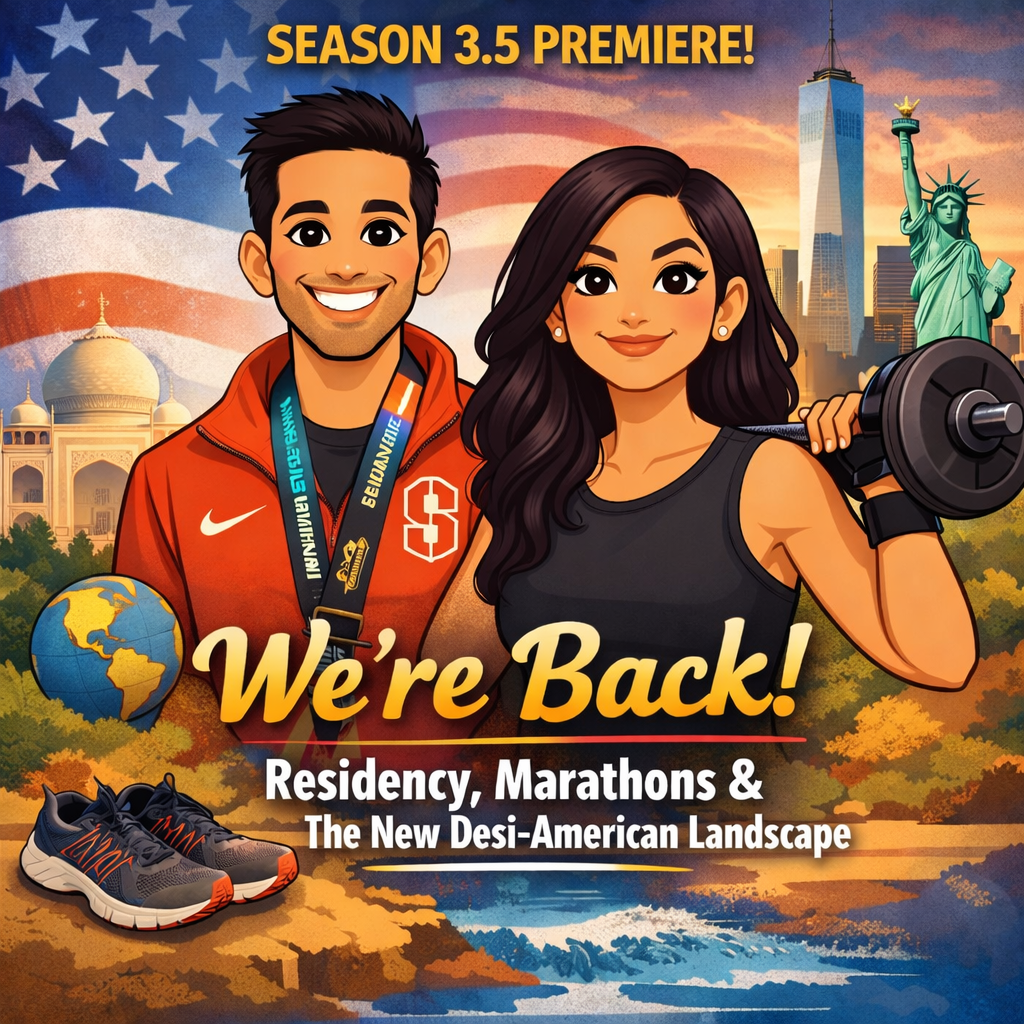
So with that being said, even though there was a lot of days where I felt like I could have made the I don't have enough times excuse, we basically held ourselves accountable. Um, and so that's basically my biggest luck, which is my partner. Um, but in terms of the type of exercise I'm doing, I'm much more of a cardio person. I was like that in medical school. And luckily I haven't had too many injuries since then, so I've been able to continue it. But Faye, my wife, she's also exposed me to a lot of different types of exercise, like high intensity interval training with Orange Theory or even just Pilates with Solid Core. These are all things that she's like, slowly expose me to. And it's really nice to. To see that. But I still think cardio has been my biggest thing. So in. In residency, I did basically three half marathons, and then I completed my second marathon, which is great because I didn't think I'd be able to do it during residency. And I definitely hit times that I never thought were possible with like a half marathon.
[00:09:59] Speaker B: Tell us your time. What's your time?
[00:10:01] Speaker A: It was, it was 90 minutes for my half, which I was like, really proud about. And then my full marathon is like 3 hours and 24 minutes. So I think now that I actually have time, I think both my wife and I definitely want to try to run a few more marathons. I think she wants to qualify for Boston and maybe me. So we'll see. I mean, only time will tell. But definitely have taken health and fitness super seriously. It definitely is way harder to do than it was three years ago, I will say that. But we're making a good effort. Sophia, what about you? What have you been up to in terms of health and fitness?
[00:10:34] Speaker B: Oh, my gosh. So I have done a couple of things, but I am nowhere near your level, Mr. Marathoner. Okay.
But I will say I have been pretty consistent with weightlifting since my second year of residency. I'm the strongest I've ever been. Like when I tell you when I was growing up, I had no muscle mass at all. Like, I was so weak. I remember in gym class it would be impossible for me to play basketball because the ball was too heavy for me to have good control and dribble it or throw it or make a basket. Like imagine if you give like a five year old or a six year old a basketball. Like it's kind of heavy for them, right? Like they're not going to have good control of it. Like that is how I was throughout high school, if you can believe that.
[00:11:18] Speaker A: So that's insane.
[00:11:19] Speaker B: Lifting weights has been the absolute best thing I could have done for myself. And you know, I'm, I'm stronger than I've ever been. And you know, this is self proclaimed, but, you know, I feel like I'm definitely stronger than the average female my age now, whereas before I was a lot weaker. So definitely proud of that. And then besides that, I've done just a ton of like Pilates, yoga. I've tried very hard to get into running, but I have failed at that. And then Farzan is teaching me to play squash, which is a new thing. So definitely trying to be very active. I like how you said it. You're. You don't want to approach uncle status.
I, I feel the same way. Definitely. Also don't want, wanna, don't wanna be an auntie just yet. Just, just turned 30. So we have, we have to, yeah, preserve, preserve our, you know, physical fitness for as long as we Can.
[00:12:10] Speaker A: Yeah. And I've. I've watched a lot of your Instagram stories, and I can tell you took a lot of, like, intentional efforts to keep up with both health. But then on top of that, the part I didn't know was your lively social life on top of residency. So I guess my question is, did you find that you had to make a bigger effort to exercise while in residency? Which I'm sure is probably going to be a yes. And if that was the case, how did you do it when you already had so many things kind of clawing at you? Like, were you just sleeping one hour a night? Or what was the thing that you compromised?
[00:12:44] Speaker B: I don't know. I mean, I feel like during my first year, I didn't exercise very much at all. But second year, when I feel like I had a little bit more grasp on things and a little more time, like a little bit less time in the hospital, and so therefore, slightly better hours, I was able to work out more. And I feel like during the weekdays, I would always try to go just immediately after work, because if I would come home and sit on the couch, there's no way I would get myself off the couch. You know, it would just be game over. So that was the biggest thing. And I feel like for me, I was almost more consistent on the weekdays because, you know, I would try to make social plans on the weekends.
[00:13:21] Speaker A: But.
[00:13:22] Speaker B: But weekdays, like, Monday through Thursday, I was definitely going to the gym after work pretty much every single day. And, you know, we all waste so much time, right? Scrolling and things like that. Like, you think you don't have 45 minutes, but, like, you really do if you just get it out of the way right after work, like, you know, you do. You do have time, especially if you don't have kids and things like that.
[00:13:46] Speaker A: Yeah, I think you're, like, so right. The way I do it is like, you have to decrease the friction as much as possible. So for you, it seems like you did it because you did it right after work, so you're already out. You're already, like, in a mindset that, like, once I get home, I'm be done with my day. So you brought your stuff with you. But I do the same thing. Like, if Faye has a meeting for 40 minutes, I know that I can't hang out with her, so I just say, okay, you go to your meeting, I'm going to go run. And that way, like, the first step is always the hardest, but you just kind of have to start. And then once you start, you Just keep going until you finish. And I think the part is. The part that's the hardest is, like, saying, I'm going to do this. And so I just say, hey, I'm going to be out for 40 minutes. I'll be back, and at least this will be done in 40 minutes. And that's a great way to get started. And before you know it, it will be a part of your schedule.
[00:14:30] Speaker B: Yeah, no, you're absolutely right. Decreasing the friction is so key. It's the only way. Honestly. It's the only way.
[00:14:36] Speaker A: Yeah.
[00:14:37] Speaker B: And I have another question. Since we're catching up on the last three years, so do you feel like there's any identity shifts from, like, being med students in our 20s to. To attendings now in our early 30s or just barely 30? How old are you? I just turned 30. Are you also 30?
[00:14:54] Speaker A: I am technically 31, although every time someone asks me that, I keep saying I'm 30. I'm, like, basically anchoring that. I don't want to be any older, but I'm technically 31, going on 32.
[00:15:04] Speaker B: Okay. Okay. For this show, you can be 30. So we're both 30. So tell us.
[00:15:10] Speaker A: So I think.
I mean, I actually went back and listened to some of our episodes, and I just feel like I had so much more optimism in my voice.
I don't know. I think as a med student, I think we knew a bit about medicine, but not nearly enough. Like, not nearly enough in the sense that here in residency, you're in the hospital 80 hours a week for 52 weeks for three years. Like, you just learn so much more about the world yourself. You learn what your breaking points are. You learn how the world goes round. You know, I've seen patients who are super young and get diagnosed with horrible metastatic cancer. You see a lot of suffering, and you also see a lot of good. You see a lot of positivity that you can accomplish.
But with that being said, I think one thing that I got to see is, like, how hard life can be. And I think you're very shielded by that when you're in school. You're also very shielded by that, even as a medical student. But as a doctor, I think you start seeing, like, wow, life's not fair.
Specifically, the part about not being fair is that people who are sometimes the most disadvantaged are also often the ones who have to deal with the most challenges. Right? People who have privilege, people who have money, they can work out a lot of big things on their own. But sometimes our society, at least in the States has affected the people who are most disadvantaged in the most negative way. And so I don't want to say I've become more pessimistic about the world, but I think I've become to realize, like, the world is not as rosy as it felt when you're just a medical student.
I also just feel like life is happening much faster.
Like maybe it's just that 27 to 31 is a very big life change anyway. Like a lot of people are getting married, a lot of people are having kids. And so aside from like those years being like crazy in the hospital, it just felt like life outside the hospital was also moving fast. Like people are buying houses and then now we have our first jobs, right? Like we're finally making a little bit of income. So you have to start thinking about like, hey, how am I going to buy a house? And you're finally approaching that pivotal point in your life where it's not just like, hey, someone's taking care of me. Whether that's your parents, your partner, your uncles and aunts, you're actually at the age now where you should be able to take care of yourself and actually even start thinking about how you're going to take care of others. And so that's a very different mindset. Um, and I think it takes a while to get used to because like, life is hard, as I said.
And so because of that, like I've just started taking finance a little bit more seriously. I've been taking like life a bit more seriously. Like how would you do this if you had kids? How would you do this if X, Y or Z happened?
And because of all of that, I think I'm also way more involved with politics and current events because all of this stuff impacts us way more now, right? Like, like these policies seem very silly as like a student or even as a 18 year old and now you're suddenly 30 and changes to taxes, changes to insurance, changes to Medicare actually impact you and people you care about. So I'm much more invested in like current events, the stock market, seeing how policy changes day to day.
It just sounds drastic, which is crazy, but I don't think I would have ever cared about that much stuff three years ago. What about you? I know that was a lot.
[00:18:24] Speaker B: No, that's all very interesting and I feel like what you said about thinking about how you're going to take care of others, like some of that is just a very also South Asian mindset, which I, I definitely appreciate. But like when you mentioned stock market, oh my God, you sound so much more mature than what I'm about to say.
[00:18:44] Speaker A: Well, I technically did business school. That's the only reason I can say that.
[00:18:48] Speaker B: I don't know. I feel like, for me, I do personally feel a bit more of a timer. Like, partly because, yeah, I'll probably try to have a child in a couple years, but also because life just feels like it's going by so fast, and you kind of feel your mortality a bit more as you get older.
You know, I do feel it. Like, yeah, we are getting older. If our son has a couple gray hairs, our parents are getting older, our friends are starting to have children. So I think when you're young, the future just feels so long and expansive. And then as you get older, you realize that time is so, so limited.
I have an example I can give you just off the top of my head.
One of the trips that Farzan and I want to do is a safari. We want to go to Kenya, but it hasn't quite worked out yet where we can both take the necessary, like, time off of work at the same time. And then as we're looking ahead over the next couple years, we're realizing, you know, we have a couple other trips we want to do. There's some destination weddings we're going to.
And we're kind of just realizing, like, oh, my God, we might not be able to do this trip before we have a child. And then at that point, you just want to wait until, you know, your kids are 8 or 9, when they're old enough to enjoy a safari, right? So, like, even that planning is like, oh, my God, where is the time going? I can't believe that we're thinking about, you know, when we have kids that are 8 or 9 years old. Like, it really makes it feel like, yeah, we. We do not have all the time in the world.
[00:20:13] Speaker A: Like, in medical school, I feel like I remember, like, we could make plans with our friends within, like, a week. I could just be like, hey, are you free today even? Or in a week? And we could come up with plans. And now it's like, even any sort of trip or any family thing, I feel like I need to let people know, like, six months in advance, because everyone else's life is also, like, exponentially more complicated. And I'm surprised you're saying Farzan only has a few gray hairs, because I have them all over the place.
[00:20:40] Speaker B: I didn't see that many at your wedding.
[00:20:42] Speaker A: So, yeah, thankfully, they're hidden. But, no, I agree with you. I think it's like, life is happening, but it's also happening for everyone else. And so if your friends are the same age as you, kind of like what you're saying, like, we could have easily met up or planned a trip within a week when we were in med school. Like, oh, we'll probably be free next week, let's go to LA or something. And now it's like, oh, you want to go on a trip? You have to, like, let everyone know six months in advance. You have to, like, think about what's going to happen. Like, it just. It's like exponentially more complicated. So I definitely agree with you on that.
[00:21:13] Speaker B: Yeah, yeah, absolutely.
And then. Okay, I guess I have one last question before we wrap up this episode, this intro to season four.
So what has changed the most, in your opinion, in the South Asian American space generally? We're recording this episode in November 2025. So, like, fully. It's been more than three years since our last season came out, and I feel like it is a different landscape now. What do you think?
[00:21:43] Speaker A: Oh, yeah, totally. I actually went through all of our last episodes because, as you know, Sophia, we're trying to like, recreate our website. We're trying to see where our podcast episodes were. So our last episodes were literally about like, Covid, right? Like, 2022 wasn't even the peak of the pandemic, but it was still like the pandemic was on a lot of people's minds. And then another big one was like, we had a lot of like, episodes where we just discussed a lot of Internet memes, which I definitely don't think are a thing anymore, or not nearly as much. So I think, to kind of put it shortly, I think the biggest thing that has changed is the public health aspect. Right? Like, we don't have Covid as significant anymore. But the second thing, and I don't know, I'd be curious to hear your opinion. I personally can't tell if it's because I'm paying attention more to politics, but I'm just seeing way more South Asian representation and like, involvement in the US political landscape. And so like, for example, obviously Zoran, who's like mayor of nyc, and that just happened a month ago. But technically in the last election, the presidential one, Usha Vance, is now the second lady. The FBI directors, like, Gujarati guy, like, there's just like so much more desi Americans. And these are all probably first or second generation desi Americans, just like us in the limelight in terms of policy making. So it's very different landscape. Like, I don't think there was anyone who I can remember in 2022 that I'm like, oh, yeah, wow. They see American doing that. But now it's like mostly a lot of big ones.
Politics.
[00:23:17] Speaker B: Yeah. Yeah, absolutely. I feel like South Asians as a whole have become so much more vocal. Like, you know, we're still a minority the way we were when our last season of this podcast came out. Right. But I kind of feel like before we were seen but not heard in a way, if that makes sense. But now the individuals who are in the public sphere feel a lot more vocal. Zoran being a great example of that. Right.
Centering the South Asian American immigrant experience in his campaign, for example. He's not just a token minority. Right. He's sharing his views so vocally.
And then even besides that, I just feel like there's so many more South Asian American content creators and like good ones too.
There's more like busy restaurants in New York that are kind of like fine dining, more chic, high end vibes in a way that kind of reminds me of London.
So, I don't know, I just feel like in the pop culture, like, I don't even know if pop culture is the right word for it, but just in the social space, I feel like South Asian Americans have had a little bit of a glow up in the last three years while you and I were head down in residency. Definitely not having a glow up exactly.
[00:24:32] Speaker A: They compensated for us. But it's gonna. This season is gonna be fun. I think it'll be. There's so many topics to talk about. There's so many nu nuances, both just the way our world is changing and also globally the transformations we're seeing around the world. So I'm sure we're going to have no scarcity of things to talk about. I'm so excited to continue dissecting our culture. And you and I started this while we were in medical school and now we're done with residency and attending. So we are also going to see that transformation in ourselves and use that as a reflection. So I think it'll be really fun. I have a lot of high hopes and hopefully everyone else is as excited as we are. What are your thoughts?
[00:25:14] Speaker B: Yeah, hopefully we can have a glow up here at Red, White and Brown to, you know, match what our peers are doing. So high hopes and we will see you guys in the next episode.
[00:25:27] Speaker A: Bye, everyone.